
Why weather claims fail
Ask a claims consultant and they will tell you that weather is the most common delay cause cited and the one with the lowest success rate. Not because the weather did not happen, but because the contractor cannot show four things:
- That the weather was abnormal for the place and the season, not just unpleasant.
- That it stopped critical work, not just some work.
- For how long, in hours and days, with idle crews and equipment counted.
- That notice was given in the form and within the time the contract required.
Weather station data proves the first. Only your daily reports prove the second and third. Only your correspondence proves the fourth. This article is about producing all three, on the day, without hiring anyone. For other kinds of delay (owner changes, late information, suppliers, concurrent delay), see our guide to construction delays, and for what late completion costs, liquidated damages.
This is general information from a software builder who has read a lot of daily reports and contracts, not legal advice. When money is at stake, get a construction lawyer or a scheduling consultant to read your clause.
What to record on the day
The daily report is the primary evidence. The template you use matters less than whether these fields are in it and filled in.
Conditions, with a source
Temperature (high/low), precipitation, wind speed and gusts, ground conditions. Name the source: "NWS station KORD" or "Met Office, Heathrow" or "site rain gauge, 23 mm at 07:00". If your software pulls weather automatically for the site address, check the station it uses and mention it once in the first report of the project.
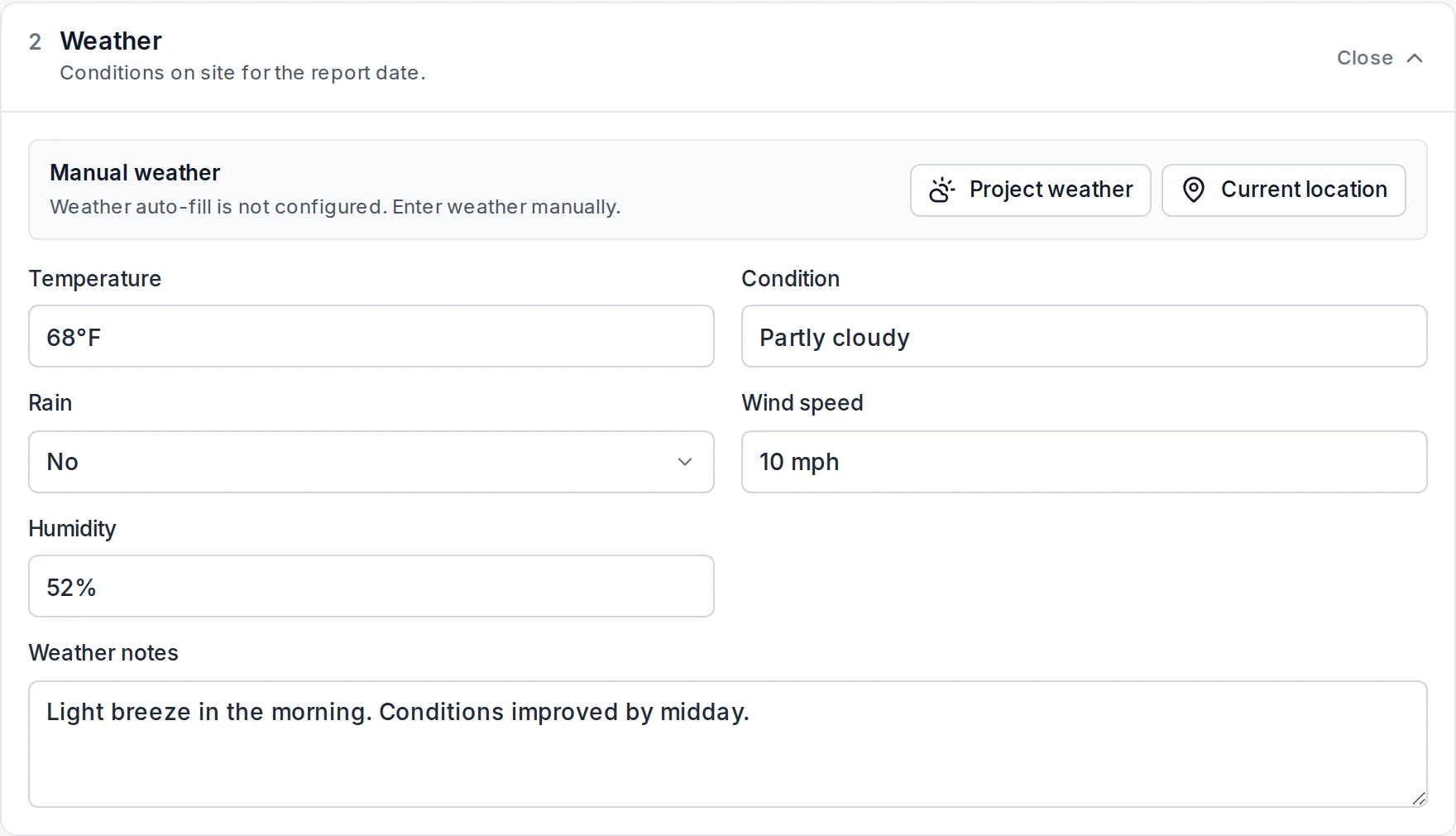
Impact: what stopped, when, and why it could not proceed
This is the field that most reports leave empty. Write it as a sentence with times:
Rain 09:40–14:15 (17 mm). Exterior masonry on west boundary wall stopped 09:40; mortar cannot be placed in rain per spec 04 20 00. Roofing membrane stopped, substrate wet. Crew of 6 moved to interior blockwork Block B from 10:15; 2 roofers stood down at 11:00. Site unworkable for exterior trades remainder of day; ground saturated.
Notice what that paragraph contains: the times, the activities, the technical reason each could not proceed (rain and mortar, wet substrate), what you did to mitigate, and the crews affected. A tribunal reads that and understands the day. "Rain, no exterior work" tells them nothing.
Time lost, per activity, per crew
Put the same event in the delays section as a row: type Weather, start and end time, hours lost per crew, equipment idled. If a pump or a crane sat idle, log the hours even if you cannot recover the cost; the record of idle time supports the extension.
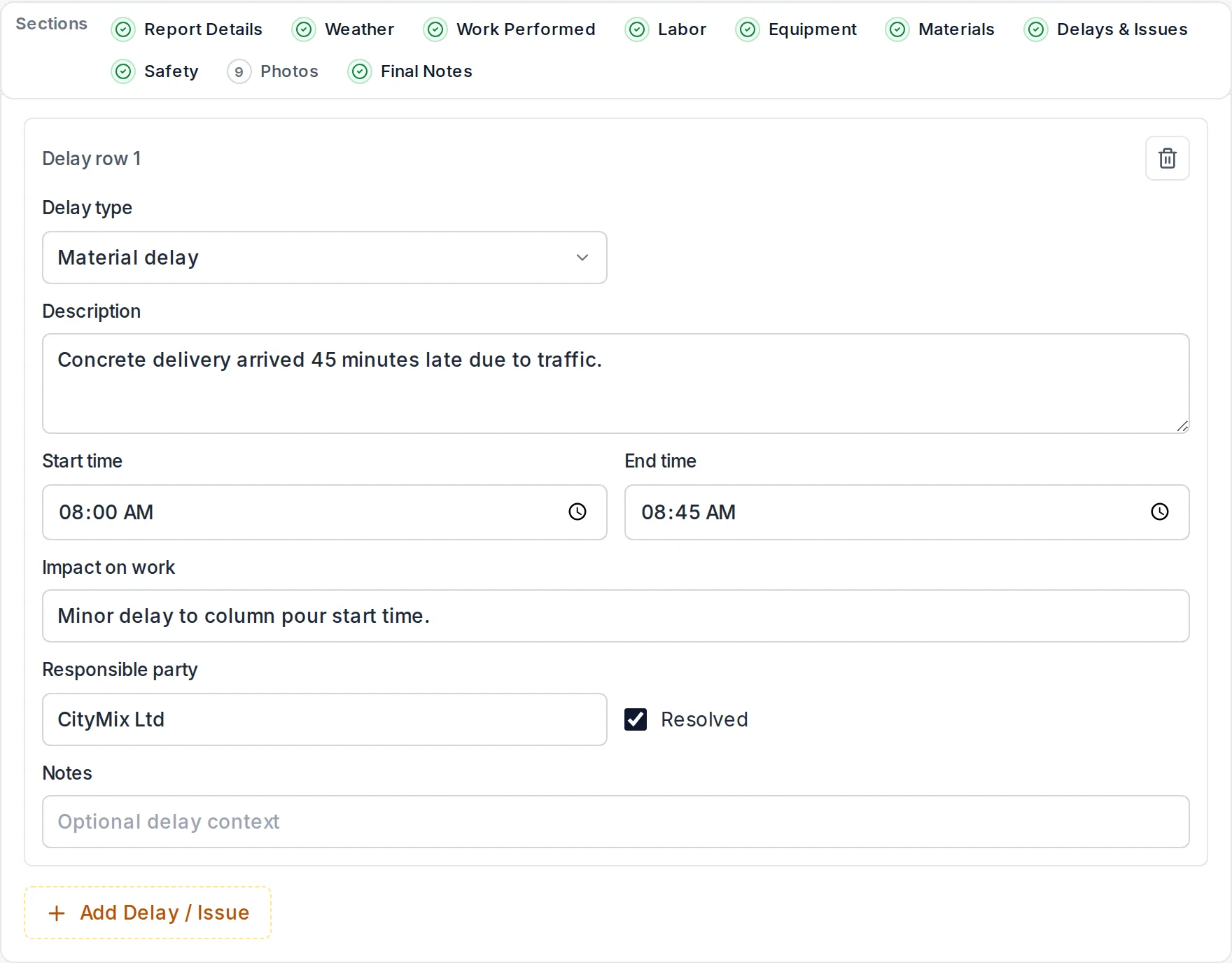
Which activities are critical
You do not need a CPM schedule on the phone, but the report should say what was planned for the day, so the record shows what was prevented. If the stopped work is on the critical path, say so: "Column pour L2 planned today; postponed to Thursday; follow-on formwork L3 shifts accordingly."
Photos with timestamps
Standing water in the excavation. The rain gauge. The wind meter. The empty scaffold at 10:00 with the sky behind it. The thermometer on the formwork for a cold-weather concrete stoppage. Photos taken inside the reporting app carry the time and location automatically; photos from a phone gallery need the metadata preserved and the file kept with the report.
Ground conditions the day after
Weather delays outlast the weather. Saturated ground, frozen subgrade, flooded trenches and wind-damaged temporary works extend the stoppage. Record the condition each following day until work resumes, with the reason: "Trench B flooded to 400 mm, pumping from 07:00, excavation resumed 13:30."
Mitigation
Contracts and tribunals expect you to have done something. Record it: crews moved indoors, work resequenced, tarps, heaters, pumps, weekend catch-up offered. Mitigation recorded on the day is evidence of good faith; mitigation asserted a year later is an argument.
How "normal weather" works in the main contract forms
The details differ, but the logic is the same in most standard forms: you carry the risk of expected weather, the owner carries the risk of exceptional weather, and you must give notice.
| Contract family | Typical test | Notice | Time / money |
|---|---|---|---|
| AIA A201 (US) | "Adverse weather conditions not reasonably anticipatable"; the contractor must show the weather was abnormal for the period, could not have been anticipated, and had an adverse effect on the scheduled construction | Within the period stated in the contract (commonly 21 days from the event) | Time; cost only if the contract adds it |
| ConsensusDocs 200 (US) | Adverse weather not reasonably anticipated, often with a schedule of anticipated weather days per month | Prompt written notice as stated in the contract | Time; some editions allow cost for extreme events |
| Public agency specs (US state DOTs etc.) | Fixed anticipated weather days per month; extension only for days beyond the table, often only if the day was a "lost day" on critical work | Per spec, sometimes daily reporting of lost days | Time |
| FIDIC (Red/Yellow Book, international) | "Exceptionally adverse climatic conditions" (Sub-Clause 8.4/8.5 depending on edition) | 28 days from when the contractor became aware, time-barred if late | Time; cost generally not recoverable under the standard wording |
| JCT / NEC (UK) | JCT: "exceptionally adverse weather conditions" as a Relevant Event; NEC: weather measured against 1-in-10-year data at the stated location, assessed per calendar month | JCT: as soon as it becomes reasonably apparent; NEC: early warning plus compensation event notice within 8 weeks | JCT: time; NEC: time and cost for qualifying weather |
Two practical consequences. First, if your contract has a table of anticipated weather days, your monthly report needs a running count of lost days against it; the claim is for the excess. Second, the notice clocks are short and some are time bars. Put the notice period from your contract on the wall of the site office.
The notice of delay
Notice is a letter or email, sent to the address in the contract, that says: a delay event has occurred, this is what it is, this is what it is affecting, we will quantify it and we reserve our rights. It is not the claim. It does not need the final number of days. It needs to be on time.
The template in the downloads box at the top of this article covers the standard content. The structure:
- Reference: project, contract, clause relied on.
- Event: dates and description of the weather, with the data source.
- Effect: which activities were stopped or slowed, referencing daily report numbers and dates.
- Status: ongoing or ended; anticipated further effect if ongoing.
- Mitigation taken.
- Reservation: that you will submit particulars and a revised programme, and that you reserve rights to an extension (and cost where applicable).
- Request: acknowledgement, and any information or decision you need from the owner.
Send it from the person named in the contract to the person named in the contract, by the method the contract specifies. Then keep filing daily reports; the notice opens the file, the reports fill it.
The records checklist
Print this and put it next to the notice period on the wall.
Every day it happens
- Conditions with source and times
- Activities stopped, technical reason, start and end times
- Crews and equipment idled, hours
- What was planned and is now displaced
- Photos: site conditions, gauges, empty work fronts, with time
- Mitigation taken
- Signed and timed before leaving site
The day after, until normal
- Ground and access conditions, with times work resumed
- Continued idle time
Within the notice period
- Written notice, referencing the daily report numbers
- Running tally of lost days against any contractual allowance
At the end of the event
- Particulars: total lost days, critical activities affected, revised programme, cost if the contract allows
Tools that help, and what they do not do
A reporting app helps in three ways: it pulls the weather for the site address automatically so the source is consistent, it forces the delay to be recorded as type, times and impact rather than a sentence in a notes box, and it stamps the photos and seals the report so nobody can suggest the record was improved later. Daily Site Log does all three on the free plan; other tools are compared in the software guide.
What no tool does is decide whether the weather was exceptional or whether the stopped work was critical. Those are questions for the contract and, often, for a scheduler. The tool's job is to make sure that when that conversation happens, you are holding the day's record and the other side is holding a recollection.
Sources
- AIA A201-2017 General Conditions of the Contract for Construction
- ConsensusDocs 200 Standard Agreement and General Conditions
- FIDIC Conditions of Contract (bookshop)
- JCT contracts
- NEC contracts
- US National Weather Service
- NOAA National Centers for Environmental Information — climate data
- UK Met Office
Frequently asked questions
What counts as an excusable weather delay?
Under most standard forms, weather that is unusually severe for the location and season and that actually prevents critical work. Ordinary rain, heat or cold that a reasonable contractor should have expected is not excusable, which is why many contracts define a baseline number of 'anticipated weather days' per month. The delay must also be on or near the critical path; weather that stops non-critical work is not a delay to completion. Check the specific clause in your contract.
How many rain days are 'normal'?
It depends on the contract and the location. Many public and some private contracts list anticipated adverse weather days per month, derived from NOAA or national meteorological averages for the site. Only days beyond that allowance count toward an extension. If your contract has no schedule of anticipated days, the comparison is usually against the 10-year average for the site, which is why the daily report should cite a specific weather station.
Do photos really matter for a weather claim?
Yes. A timestamped photo of standing water in the excavation, or a wind meter reading next to the crane, turns a weather report into site-specific evidence. Weather station data shows it rained in the region; the photo shows it stopped your work.
Do I get money or just time for a weather delay?
Under most standard forms weather is excusable but not compensable: you get an extension of time and relief from liquidated damages, but not your extended overhead or idle equipment costs, unless the contract says otherwise or the weather event compounds an owner-caused delay. Read the clause; some negotiated contracts do allow cost recovery for extreme events.
What if I did not send notice in time?
Send it now, explain the reason, and keep documenting. Some jurisdictions and tribunals excuse late notice where the owner was not prejudiced or had actual knowledge, but many enforce notice provisions strictly. Late notice with excellent daily records is a weaker position than timely notice; it is far stronger than no notice and no records.