
What a construction daily report is for
Every construction contract assumes someone is writing down what happened each day. Progress payments, extension-of-time claims, back-charges to subcontractors, safety investigations and the argument about whether the tile really was late all come back to the same question: what does the daily report say?
The report has three audiences, and the template needs to work for all of them:
- The office, tomorrow. Did the pour happen? How many people were on site? What do we need to chase?
- The owner or client, this week. Proof that they are getting what they are paying for, and early warning when something is slipping.
- A lawyer, arbitrator or insurer, in two years. The contemporaneous record of a delay, an incident or a defect. This audience is the reason the report must be dated, signed, specific and unaltered.
Most reports are written for the first audience and fail the third. The rest of this article is about writing one that serves all three without taking more than ten minutes.
The ten sections, and what each one has to contain
Section names vary by company and software. The content below is what a report needs regardless of what the headings are called. Screenshots are from Daily Site Log; the free template reproduces the same sections on paper.
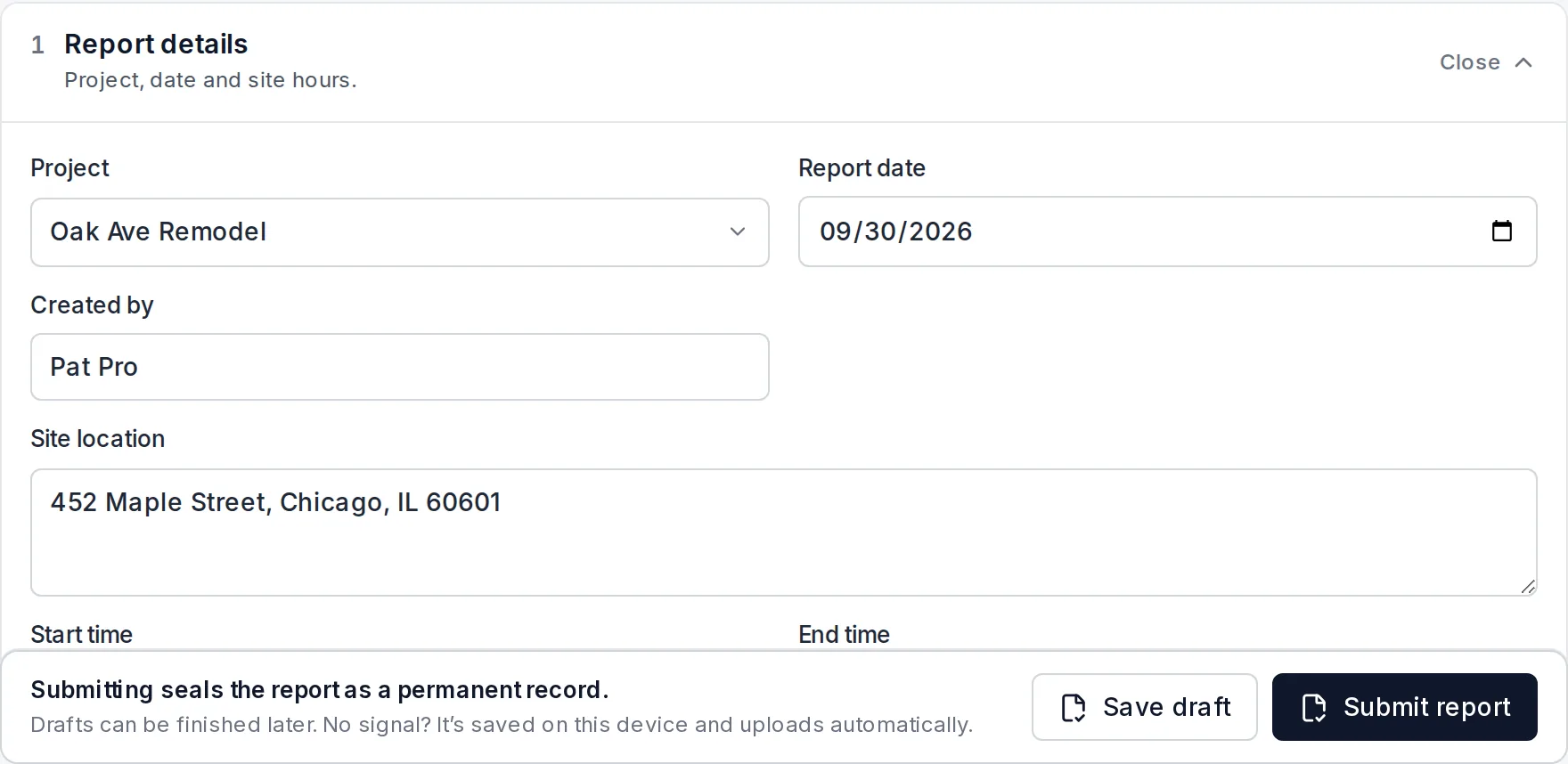
1. Report details
Project name, address, report date, report number, who prepared it and their role, site hours, client. The report number should be sequential per project; a gap is the first thing a claims consultant looks for.
2. Weather, and what it did to the work
Record conditions at least at start of shift and midday: temperature, precipitation, wind, and the source (a named weather station or service). Then the part most reports skip: impact. Which activities stopped, from what time to what time, and how many people were affected. "Rain" is not a delay. "Rain 10:05–13:10, exterior masonry stopped, 6 workers reassigned to interior blockwork" is.
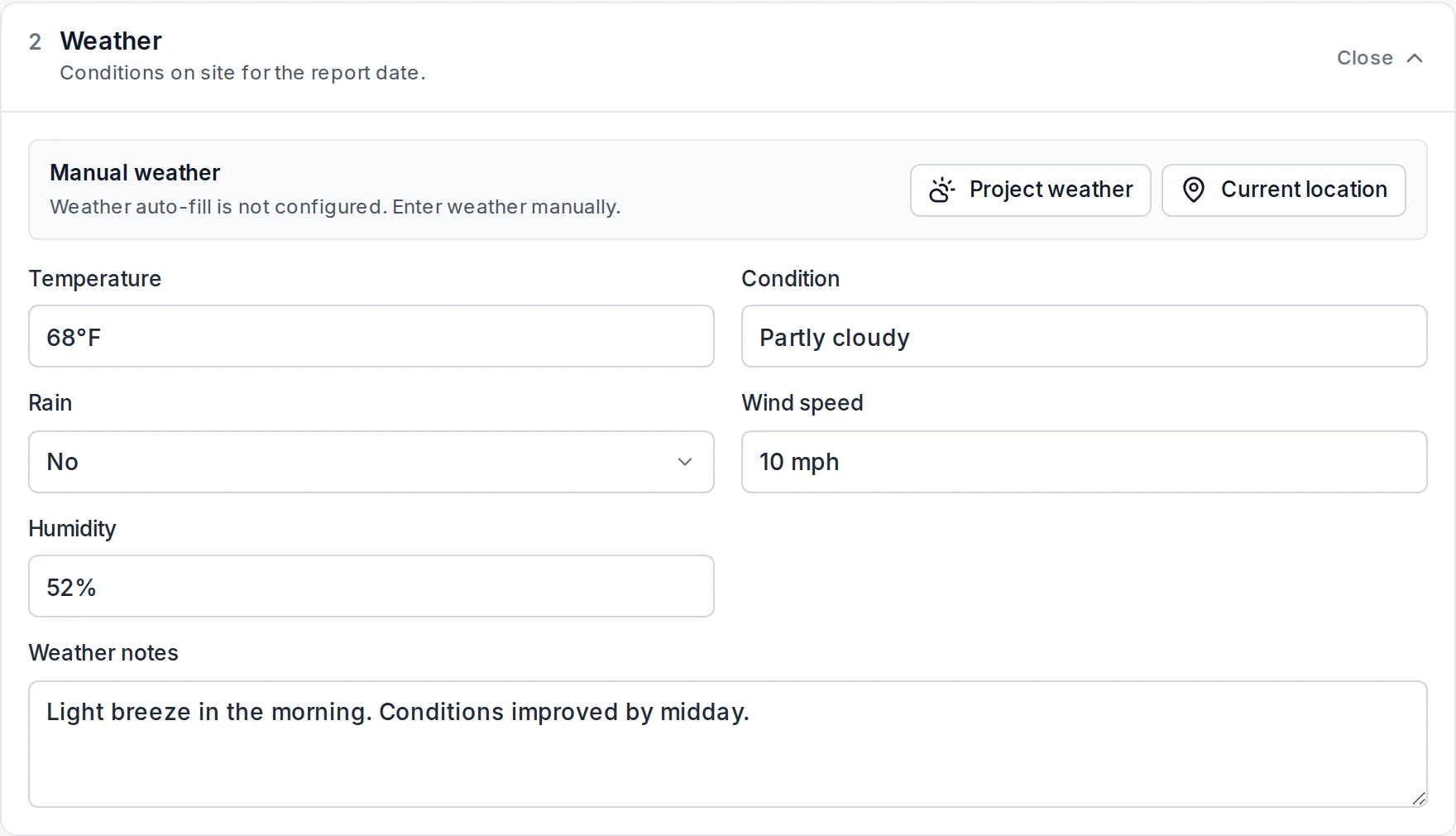
Weather claims rarely fail because it did not rain. They fail because the contractor cannot show that this rain stopped this work for this long. See how to document weather delays so the claim holds.
3. Work performed
One line per activity, each with a location: zone, grid line, level, room. Then subcontractors on site and the plan for tomorrow. The plan matters: when a delay hits, the record shows what you intended to do and therefore what was prevented.
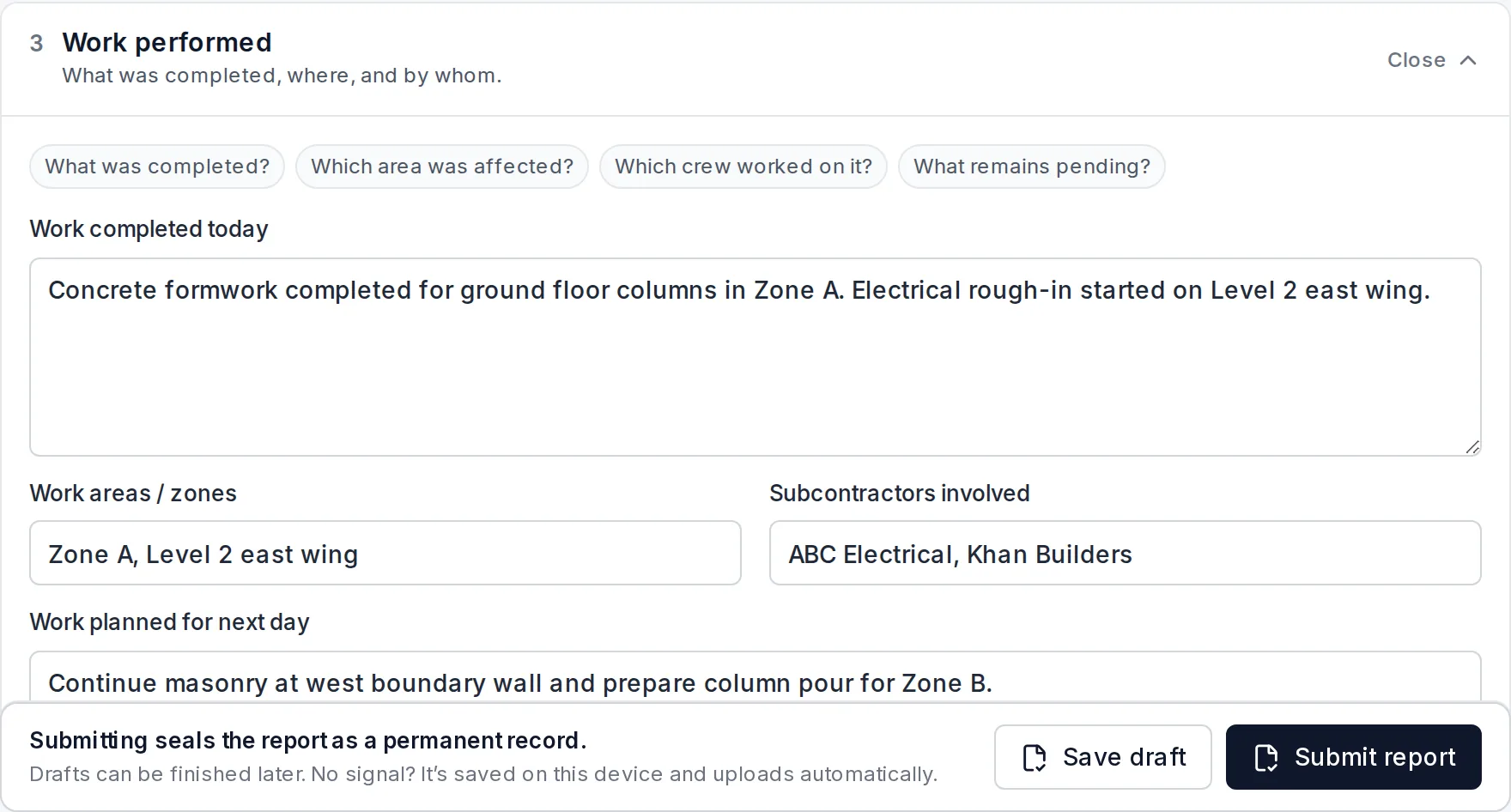
Weak: "Formwork." Usable: "Column formwork C4–C9, Level 2, Zone A — 80% complete; pour scheduled Thursday."
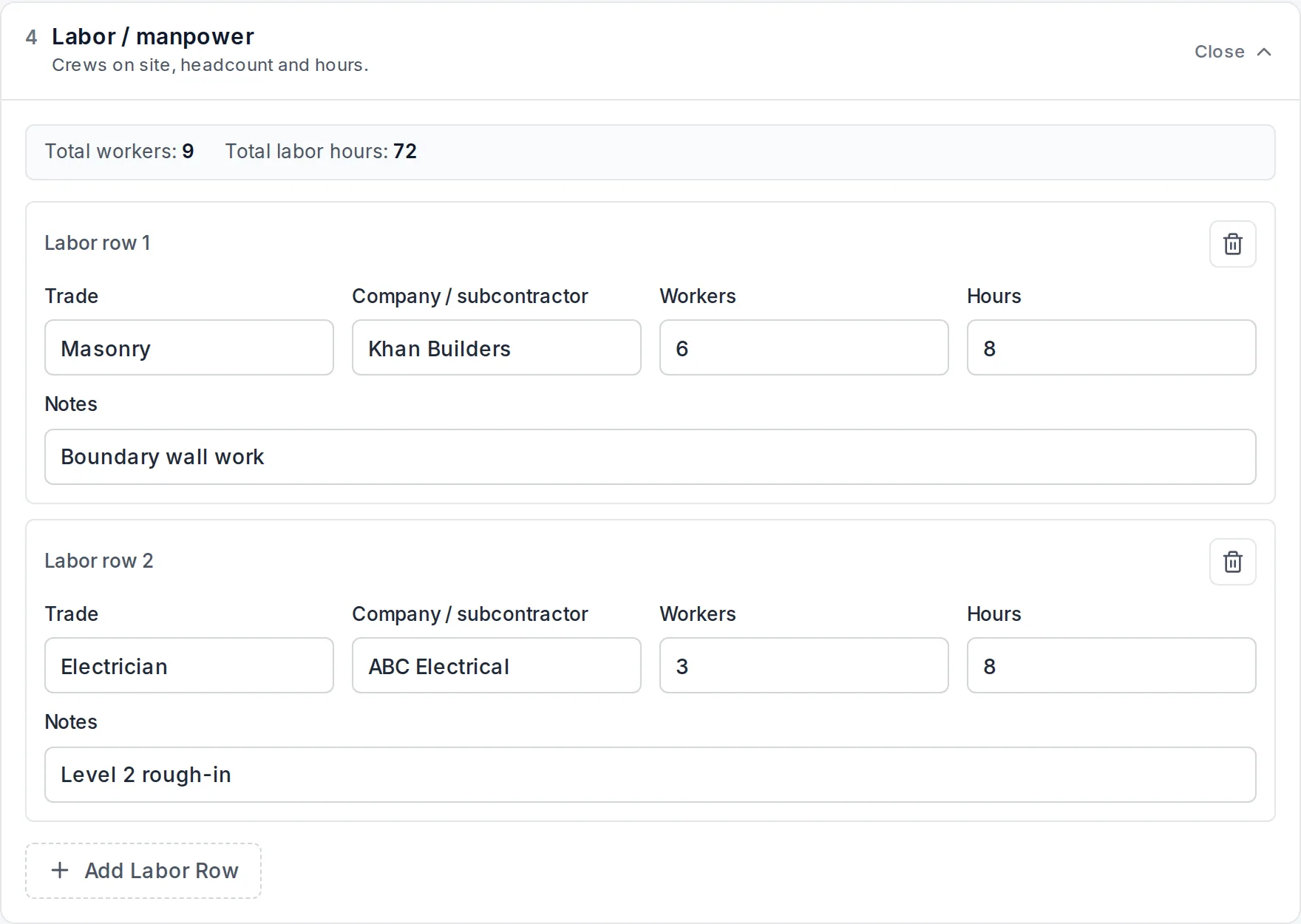
4. Labor / manpower
Every trade on site, the company, headcount and hours. Own crew and each subcontractor separately. This table is the backbone of productivity, acceleration and disruption claims: if you later argue that a design change forced you to add crews, the daily reports are how you prove the crews were added.
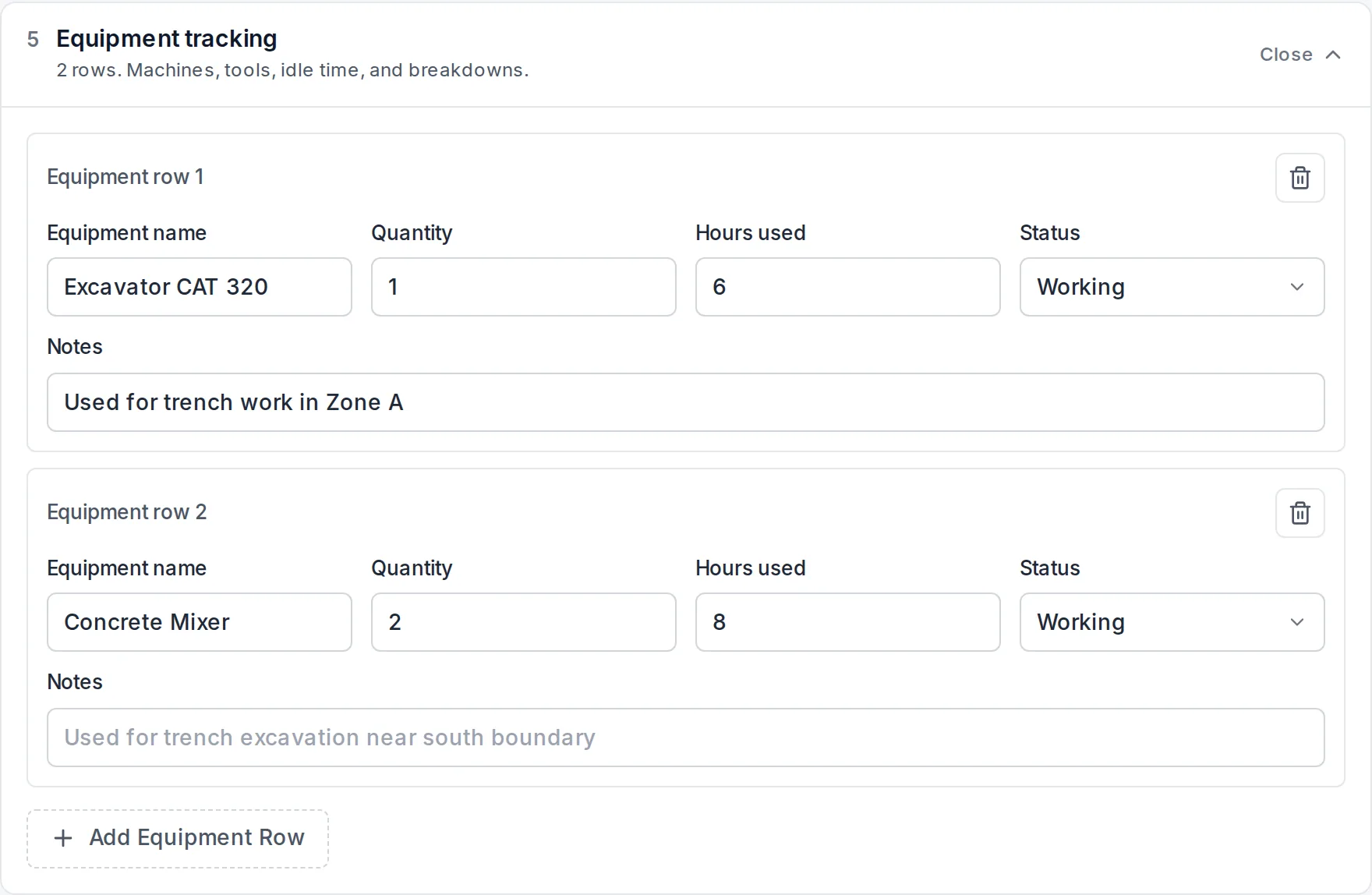
5. Equipment
Machine, quantity, hours used, and hours idle with the reason. Idle hours on rented equipment are frequently recoverable when the cause is an owner decision, a late permit or another party's delay, but only if they were recorded on the day.
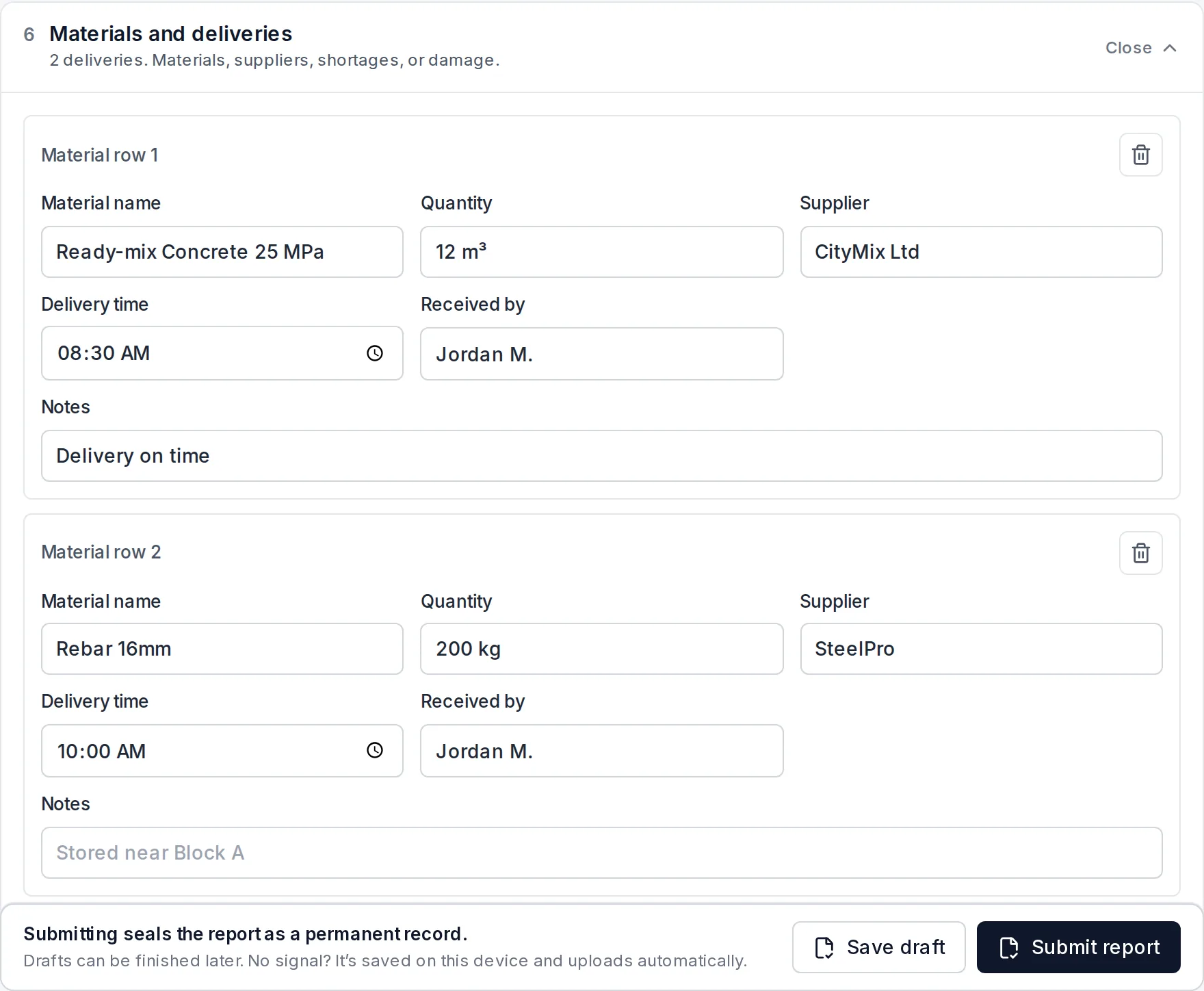
6. Materials and deliveries
What arrived, quantity, supplier, who received it, and condition or where it was stored. Late and short deliveries are the most common cause of delay on small jobs, and the delivery ticket alone does not say the pallets were broken.
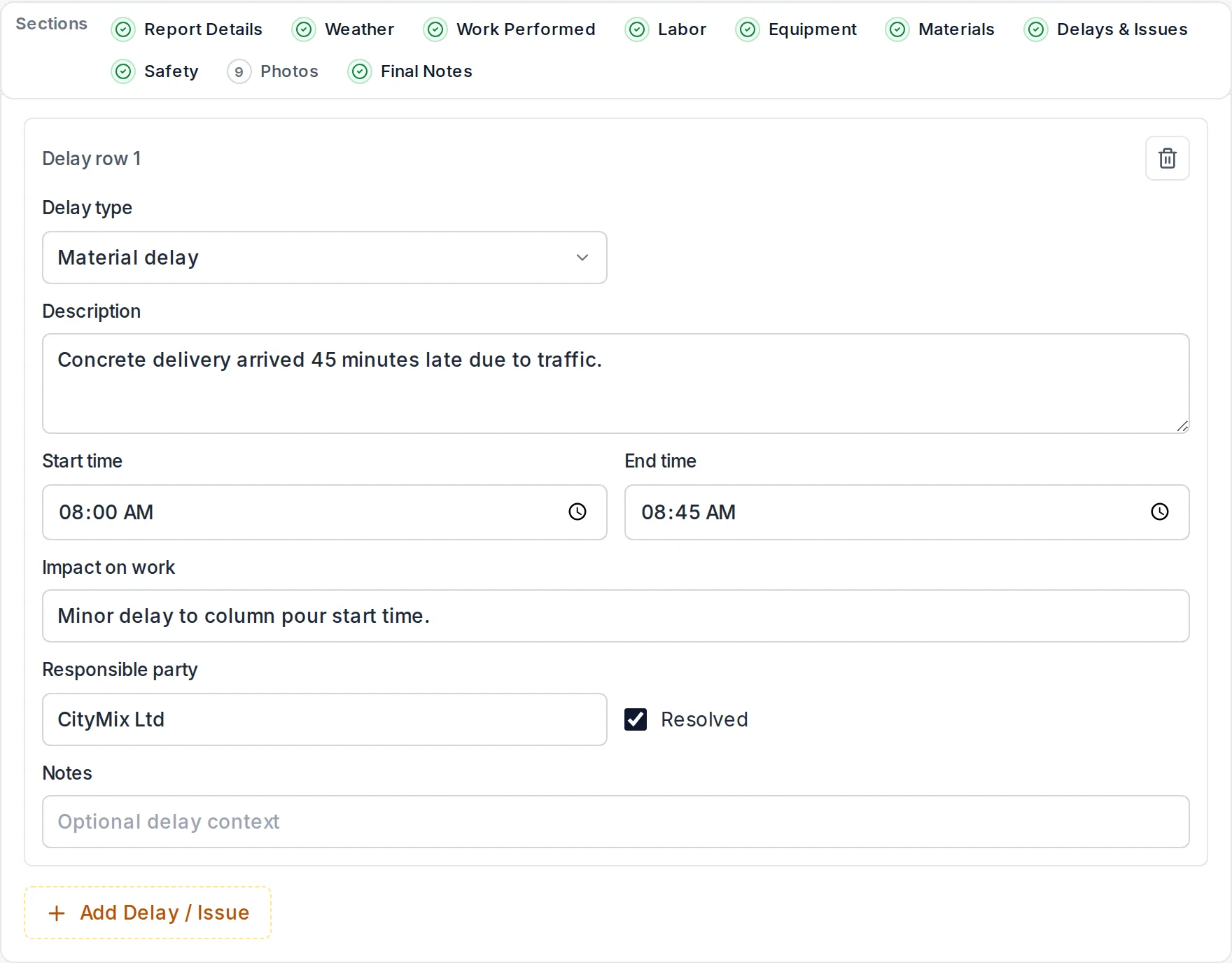
7. Delays and issues
The section the whole report exists for. For each: type (weather, material, labor, equipment, client decision, drawing/RFI, subcontractor, inspection, safety, access), what happened, start and end time or hours lost, impact on work, and the responsible party. Decide responsibility the day it happens, while it is obvious. If there were no delays, write that; silence is not a record.
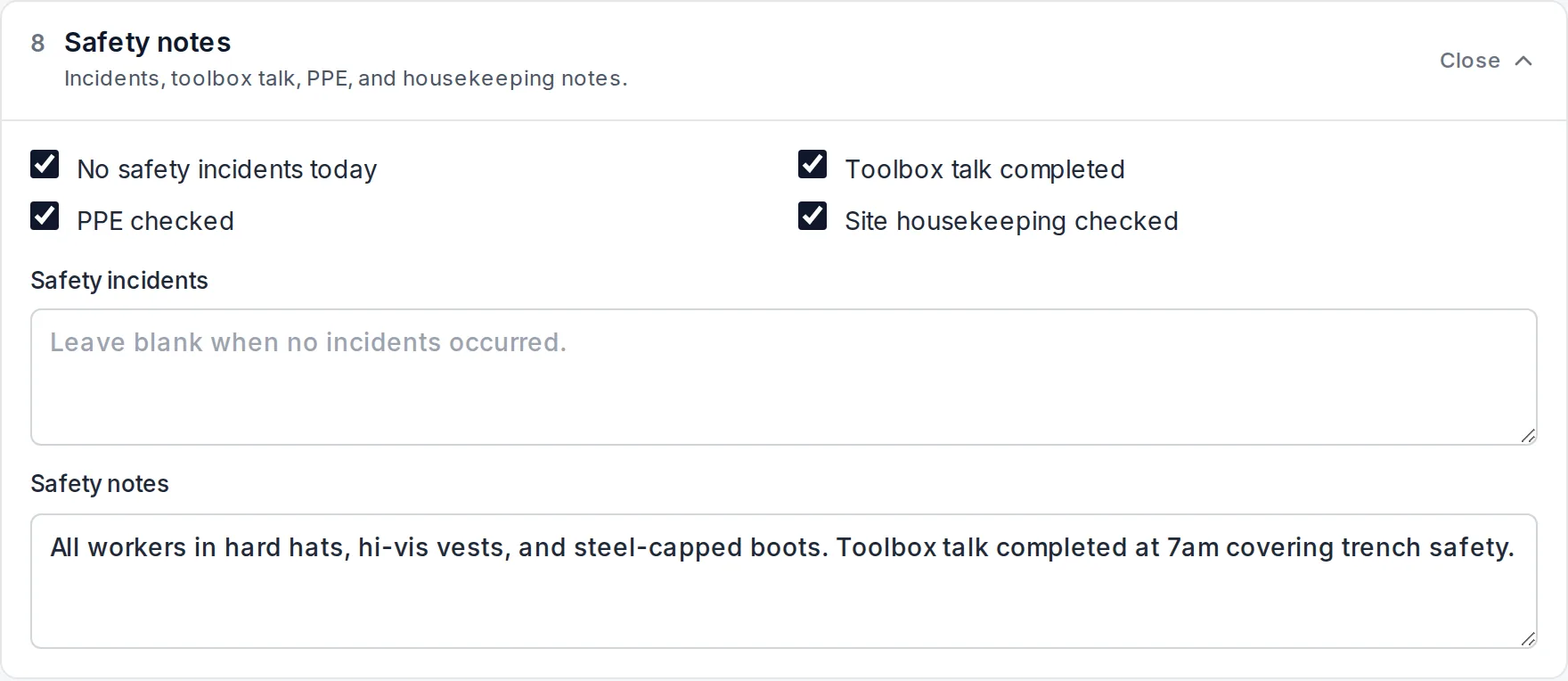
8. Safety
Toolbox talk held and the topic, PPE compliance, incidents and near misses, inspections, and visitors with times: the owner's rep who verbally approved the change, the inspector who passed the footings. Visitors are evidence of who knew what, when.
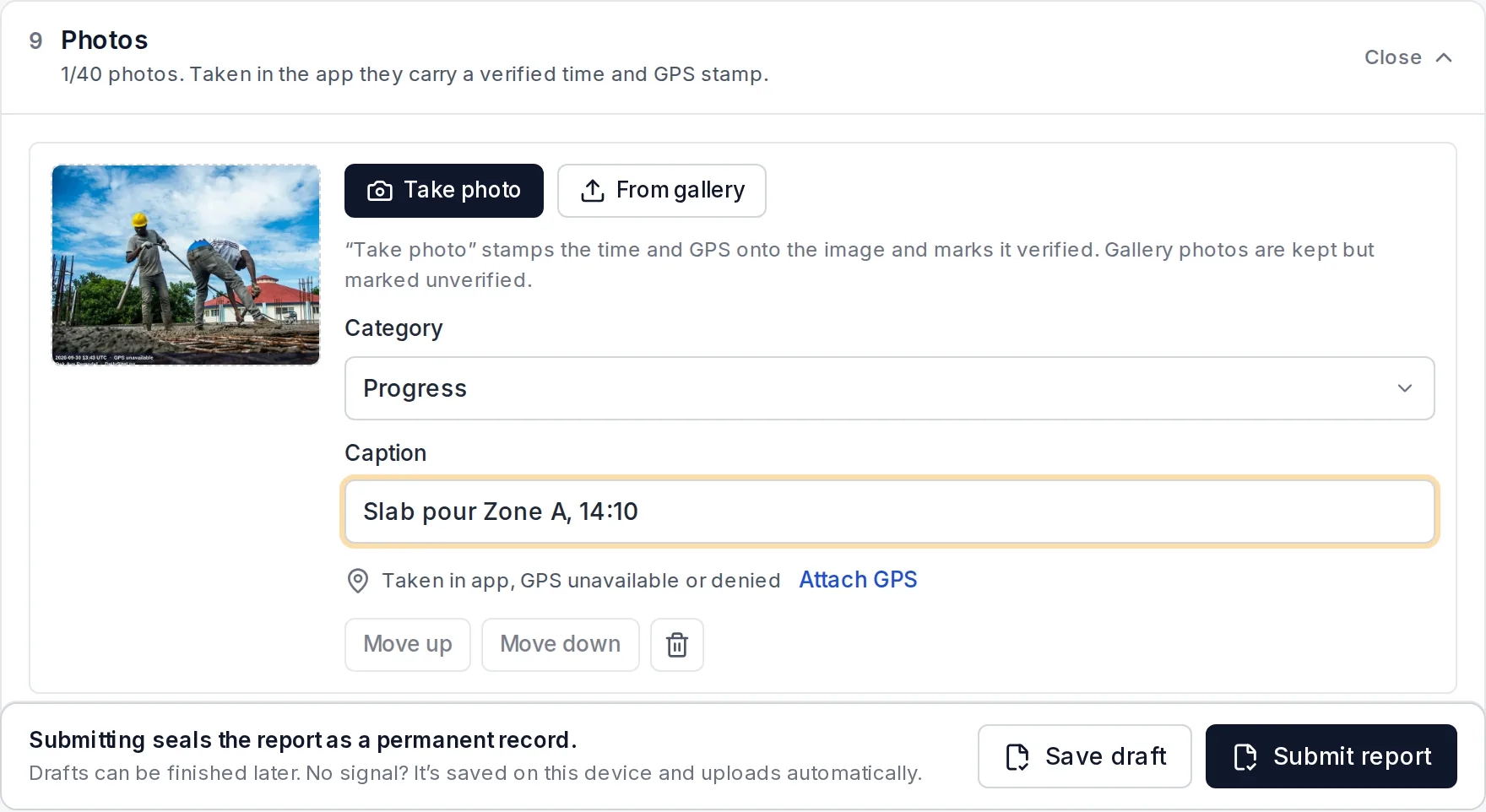
9. Photos
A photo without a caption, time and location is a photo. A photo with all three, listed in the report, is evidence. Take at least one wide progress shot from the same spot every day; over a project it becomes a time-lapse for free. Photograph every delivery, every delay condition (the flooded excavation, the empty steel rack) and every incident.
10. Notes and sign-off
Anything that does not fit above: conversations with the owner, instructions received verbally, next steps. Then prepared by and, ideally, reviewed by, each with a time. A signature at 16:50 on the day is what makes the document a record rather than a draft.
A filled example, page by page
Below is a submitted report from a demo project, as the PDF the client receives. Names are fictional; the structure is exactly what a real one looks like.
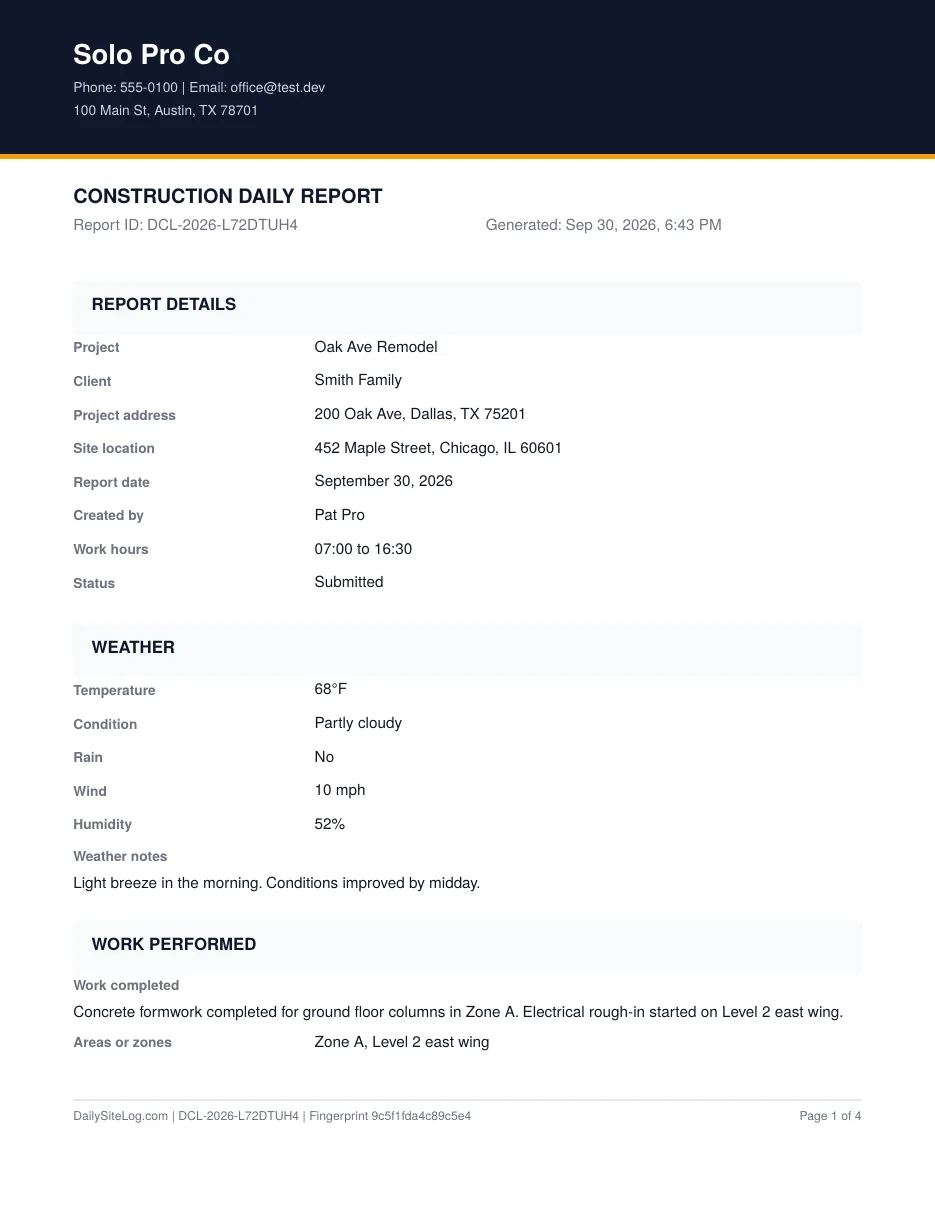
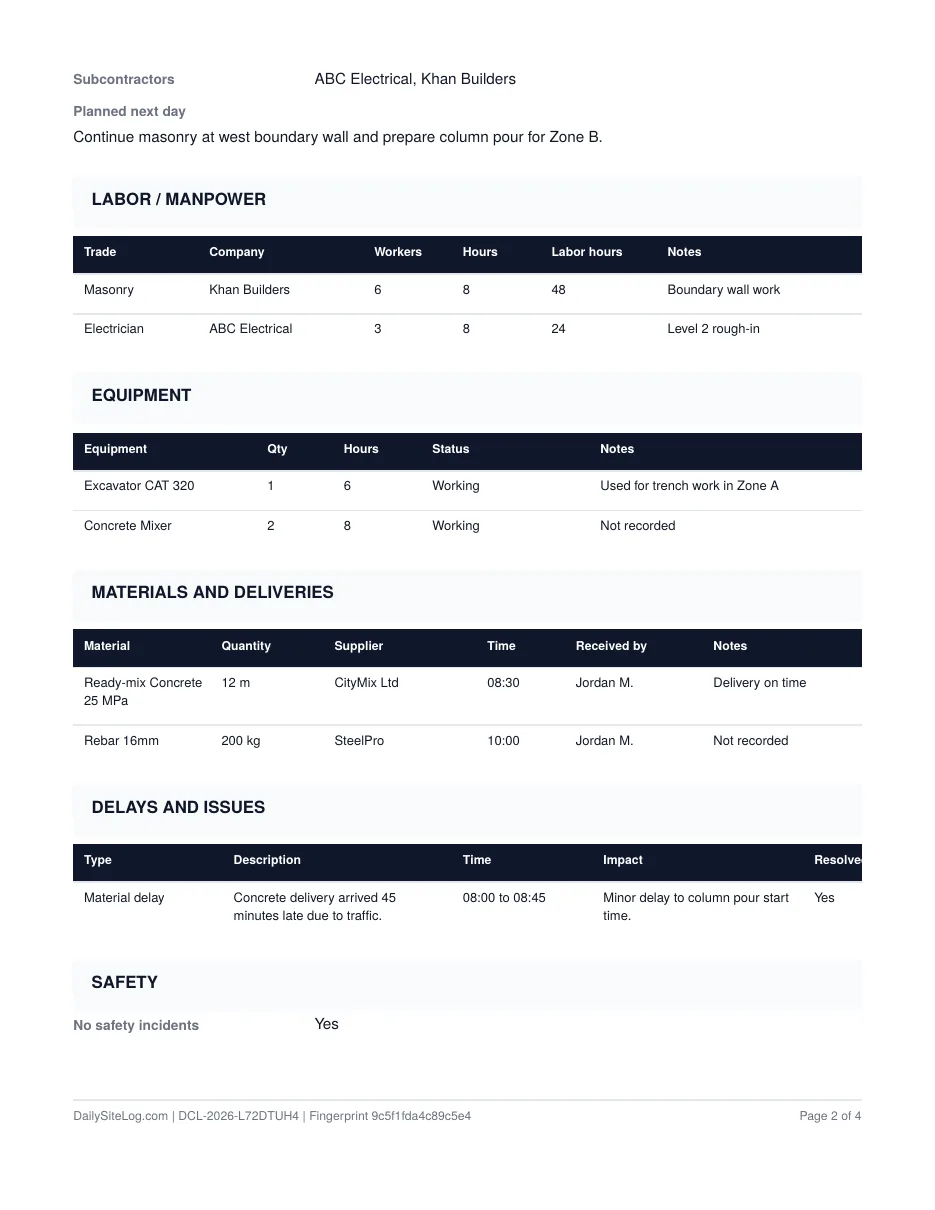
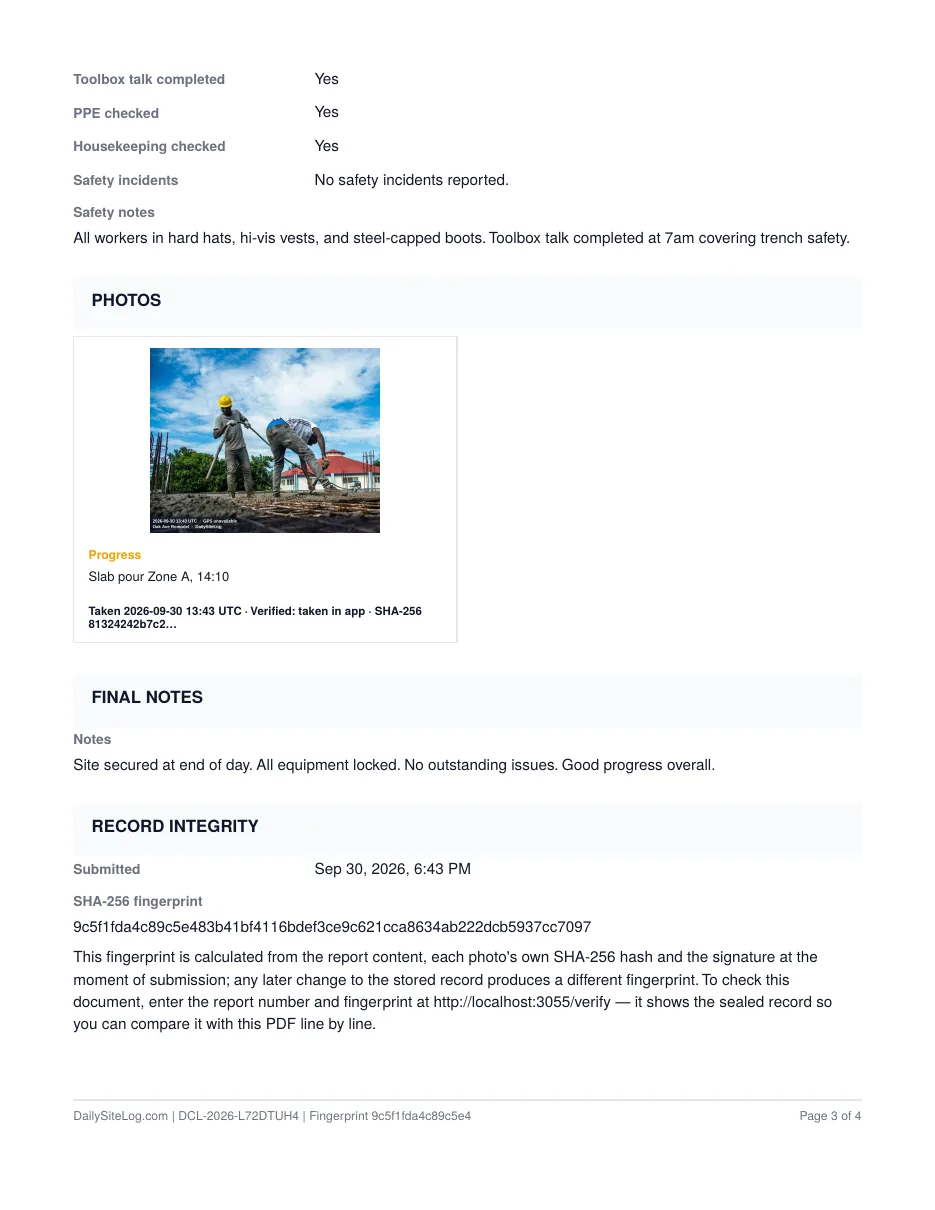
The footer on every page shows a SHA-256 fingerprint of the report content. Anyone holding the PDF can check it against the record on /verify; if a single character was changed after submission, the fingerprint will not match. That is the software answer to "how do we know this was not written last week?" On paper, the answer is the signature, the time, and a copy sent to the office the same day.
Who writes it and when
| Role | Writes | When |
|---|---|---|
| Foreman / lead (small jobs, 1–2 crews) | The whole report | Before leaving site |
| Superintendent (GC, multiple trades) | Master report; collects sub reports | End of shift; subs by 9 am next day |
| Subcontractor foreman | Own trade's report to the GC | Same day |
| Project manager / office | Reviews, signs as reviewer, files, forwards to client | Next morning |
The single most important rule: the person who saw it writes it, the day it happened. A PM typing up the foreman's WhatsApp messages the next afternoon produces a document that is hearsay in form and unreliable on times.
Common mistakes
- Writing it the next day. Times drift, headcounts round, and the credibility gap is visible to anyone who reads a month of them.
- No locations. "Blockwork" tells nobody where progress stands.
- Weather without impact. The claim needs stopped activities and hours, not a temperature.
- Delays without hours or a responsible party. Cannot be priced, cannot be scheduled, cannot be attributed.
- Photos in a phone gallery, report on paper. Six months later they cannot be matched.
- Skipping quiet days. A missing day is a missing record, not a quiet one.
- Editing after the fact. Corrections belong in a new dated note, never in the original. Software should seal the submitted version; on paper, initial and date any amendment.
- Different formats per site. Ten sections, same order, every site, every day.
Where to start
If you are on paper or Excel today, start with the free template and the ten-minute routine in it. If the same header is being retyped daily, or photos and reports live in different places, or a client has ever asked "how do we know this was not changed", it is time for a purpose-built tool; what daily report software should do and what it costs compares the options, including where free plans stop.
Sources
- AIA A201-2017 General Conditions of the Contract for Construction
- ConsensusDocs 200 Standard Agreement and General Conditions
- FIDIC Conditions of Contract (bookshop)
- JCT contracts
- NEC contracts
- US National Weather Service
Frequently asked questions
Who is responsible for the construction daily report?
The person supervising the work on site that day: the superintendent on larger jobs, the foreman or lead on small ones. On projects with several trades, the general contractor's superintendent writes the master report and each subcontractor files their own. Responsibility should be named in the contract or the site procedures, because a report nobody owns does not get written.
Is a construction daily report a legal document?
It is a business record, and in most jurisdictions a contemporaneous business record is admissible as evidence of what it describes. Courts and arbitrators give weight to reports that were made the same day, in the ordinary course of business, by someone with first-hand knowledge, and that show no sign of later editing. That is why timing, signature and an unaltered copy matter more than the format. This is general information, not legal advice.
What time should the daily report be submitted?
Before the person who wrote it leaves site, or at latest the same evening. Reports written the next morning lose accuracy on times and headcounts and lose credibility in a dispute. Many owner contracts require submission within 24 hours; some public agencies require it by 9 am the following day.
What if nothing happened on site today?
File a report anyway, saying so: no work, the reason (weather, holiday, waiting on inspection), and any deliveries or visitors. A gap in the sequence looks like a missing record; a report that says 'no work — rain day' is evidence of a weather delay.
How is a daily report different from a daily log or a site diary?
Same document, different regional names. 'Daily log' is common among US superintendents, 'daily report' is the term most owners and software use, and 'site diary' is standard in the UK, Ireland and Australia. Some contracts define a daily log as the superintendent's personal notebook and the daily report as the document issued to the owner, so check the definitions clause.