
Short version
Most delay disputes are not about whether something went wrong. Everyone agrees the steel was late. The argument is about three questions:
- Whose risk was it? That decides whether you get more time, more money, both or neither.
- Did it actually move the finish date? Only delays to critical work do.
- Can you prove it? Notice within the contract deadline, and daily records with times, crews and causes.
This guide covers all three. It ends with what to write down on the day and a free delay log you can use from tomorrow.
We make Daily Site Log, a daily report app that records delays with the party responsible. This is general information, not legal advice. When real money is at stake, have a construction lawyer or a scheduling consultant read your clause.
The four types of construction delay
Delays are classified on two axes: who carries the risk, and whether they affect the completion date. A single delay usually has a label from each.
| Type | What it means | Typical examples | What you can usually get |
|---|---|---|---|
| Excusable, compensable | Owner's risk | Late drawings or answers to RFIs, owner changes, late site access, owner-supplied materials late, differing site conditions | More time and extra cost |
| Excusable, non-compensable | Nobody's fault | Weather beyond the normal for the season, strikes, epidemics, acts of government | More time, no money |
| Non-excusable | Contractor's risk | Late mobilisation, low productivity, its own subcontractors and suppliers, its equipment breaking down | Nothing, and liquidated damages may apply |
| Concurrent | Owner and contractor delays overlap | Owner's late design release while the contractor is also behind on its own work | Usually time, no money for the overlap |
Separately, every delay is either:
- Critical: it pushes out the date the whole job can finish, because it hits an activity on the critical path.
- Non-critical: it uses up float on an activity that had slack. It may still cost money (idle crews), but it does not justify an extension of time.
Excusable delays
An excusable delay is one you did not cause and could not reasonably have avoided or planned for. Weather is the classic one, but only weather worse than normal for the location and season. Ordinary rain in a rainy month is expected and priced in; many contracts define how many weather days per month are "normal". We cover that in detail in how to document weather delays.
Compensable delays
When the owner, or someone the owner is responsible for (its architect, its other contractors, its suppliers), causes the delay, the contractor may recover the cost of the extra time as well: site overheads, equipment, supervision, sometimes head-office overhead and lost productivity. Changes are the most common route. A change order that adds work should add time, and if you sign it without asking for time, you may have given the time away.
Non-excusable delays
Your own late start, slow progress, a broken-down excavator, or your supplier or subcontractor turning up late are generally your risk as far as the owner is concerned. That surprises people. If the ready-mix truck arrives three hours late, that is not normally an excusable delay on the main contract. But it matters a great deal against the supplier, so record it just as carefully: the time, the crew and plant left standing, and the supplier's name.
Concurrent delays
Concurrency is where most expensive arguments end up. If the owner's late approvals and your own late steel would each have delayed completion over the same weeks, the usual outcome is:
- Time: you get the extension, so the owner cannot charge liquidated damages for that period.
- Money: neither side recovers its delay costs for the overlap.
That is the common approach in the US and the one recommended by the UK Society of Construction Law's Delay and Disruption Protocol, but contracts can change it and courts in different countries treat it differently. The practical lesson: if your own records show you were also behind, the owner will use them. Write facts, not excuses.
Notice: the rule that loses more claims than anything else
Most standard contracts require written notice of a delay within a fixed time. Miss it and you can lose the right to the extension, even if the delay was obviously not your fault.
| Contract | Notice of a delay or claim | Where |
|---|---|---|
| AIA A201 (US) | Within 21 days of the event, or of first recognising it | §15.1.2 (2007), §15.1.3 (2017) |
| ConsensusDocs 200 (US) | Prompt written notice; check the specific days in your copy | Article 6 |
| FIDIC 2017 (international) | Within 28 days of becoming aware, or the claim is lost unless excused | Sub-clause 20.2.1 |
| NEC4 (UK and elsewhere) | Within 8 weeks of becoming aware of a compensation event, with exceptions | Clause 61.3 |
| JCT 2016 (UK) | Forthwith, once it becomes reasonably apparent progress is or will be delayed | Clause 2.27 |
| Many public agencies | Often 3 to 7 calendar days from the start of the delay | Special conditions |
Two habits fix most notice problems:
- Send notice the day the delay starts, even if you do not yet know how long it will last. You can quantify it later.
- Log the date and reference of every notice next to the delay it relates to. The delay log template below has a column for it.
Our free notice of delay letter template has the usual wording.
What to record on the day
The claim is built later, but the evidence is created on the day or not at all. For each delay, the daily report should answer these questions in plain sentences:
- What stopped? The specific activity and location, for example "slab pour level 2, gridlines C to F".
- From when to when? Start and end time. If it is still going at the end of the day, write "ongoing" and carry it forward.
- Why? The cause in neutral, factual words: "concrete truck did not arrive until 10:05; booked for 07:00".
- Who is responsible? Name the party: owner, architect, supplier, subcontractor, weather, utility. One delay, one party where possible.
- What did it cost in resources? Crews and plant left standing, with numbers and hours.
- What did you do about it? Mitigation: crew moved to formwork, pour rescheduled, extra plant hired. Contracts expect you to reduce the effect of a delay; showing you did so strengthens the claim.
- What proves it? Photos with time and location, delivery tickets, emails, the inspector's sign-in.
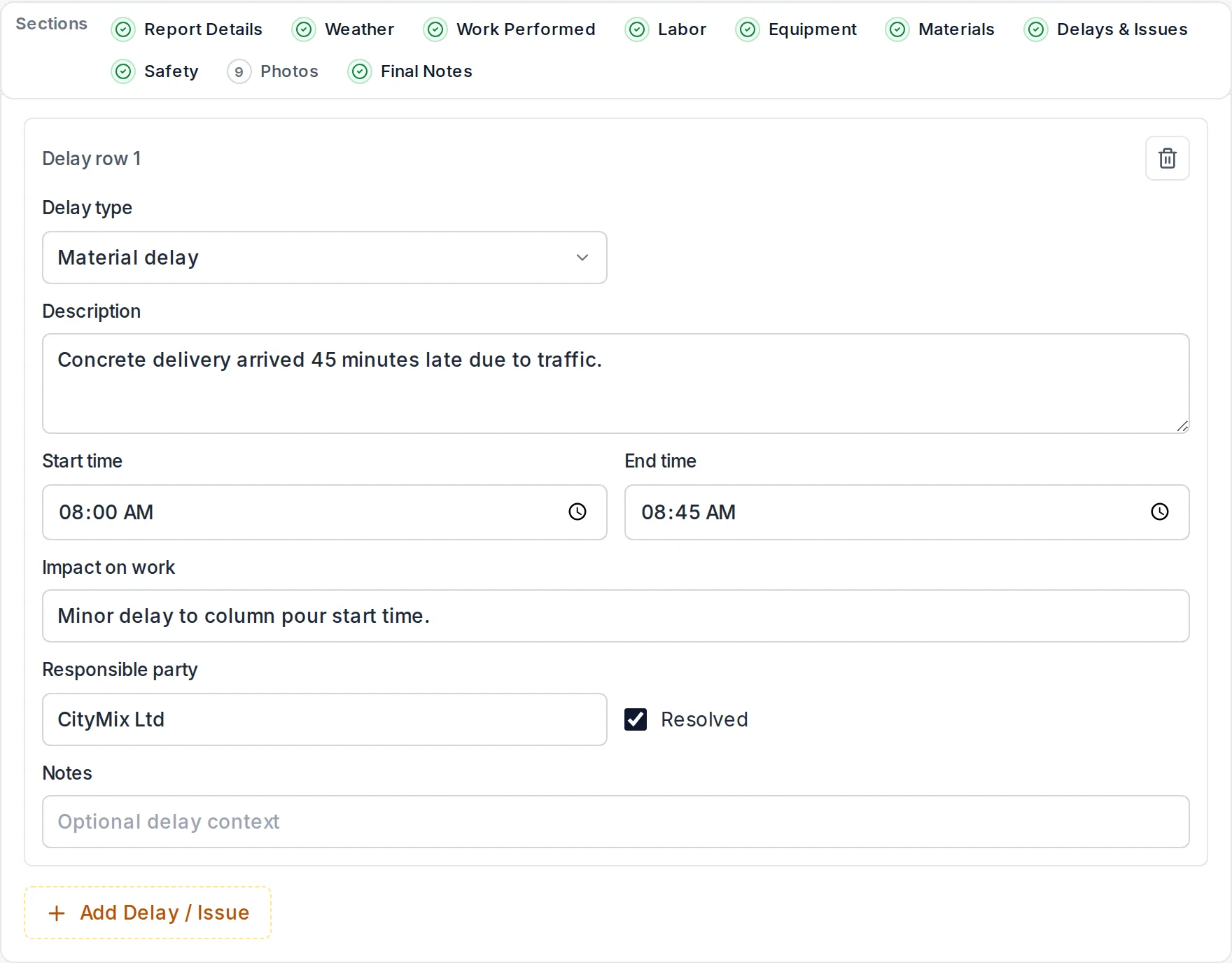
A delay written up like that, with the same day's photos, is very hard to argue with. "Concrete late, pour delayed" written three days later is easy to argue with.
Keep a delay log alongside the daily reports
Daily reports are the evidence. A delay log is the index that lets you find it. One row per delay event, kept up to date, with:
- the date, type, description and times;
- hours lost and the crews and plant affected;
- whether it hit critical work;
- who caused it, and whether it looks excusable or compensable;
- the date and reference of your notice;
- the daily report number and photos that prove it.
Download the free construction delay log template (Excel). It calculates hours lost from the start and end times and totals them. A row from a real report looks like this:
| Date | Type | What happened | Time | Hours | Caused by | Notice |
|---|---|---|---|---|---|---|
| 14 Oct | Material delivery | Ready-mix truck 3 h late; footing pour A–C could not start; 6 workers and pump on standby | 07:00–10:00 | 3.0 | Ready-mix supplier | Email D-03, same day |
How delays are analysed later
If a delay becomes a dispute, a scheduler will test it against the programme. The common methods, from simplest to most involved:
- As-planned versus as-built: compare what was meant to happen with what did.
- Impacted as-planned: add the delay events to the original programme and see how far completion moves.
- Time impact analysis: insert each event into the programme current at the time it happened. This is the method most contracts and protocols prefer for live claims.
- Windows analysis: look at the project in periods, say monthly, and identify what drove the critical path in each.
- Collapsed as-built: remove the owner's delays from what actually happened, to see when the job would have finished without them.
Every one of these methods depends on knowing exactly when each event started and ended and which activities it touched. That comes from daily records. No schedule analysis can recreate a day nobody wrote down.
A simple routine that protects you
- Record every delay in the daily report the same day, with times, cause, party and resources.
- Take two or three photos that show the problem, with time and location on them.
- Send written notice the same day if the delay could affect completion or cost.
- Add a row to the delay log and note the notice reference.
- Carry open delays forward each day until they end.
- Once a month, review the log with your scheduler or project manager and prepare extension requests while the facts are fresh.
Daily Site Log does steps 1, 2 and 4 in the app: each delay is recorded with its type, times, impact and responsible party, photos are stamped with time and GPS, and every delay on a project can be exported as one claim-ready PDF. The report is sealed when it is submitted, so nobody can say it was written after the fact. Start free, or see a sample report first.
Sources
- Fenwick Elliott — Notices under FIDIC 2017 and NEC4
- Gentry Locke — Contract claim process and schedule requirements (AIA A201 §15.1.2)
- Berger Singerman — Construction weather delay claims (AIA A201 §8.3.1 and §15.1.6.2)
- Society of Construction Law, Delay and Disruption Protocol (2nd edition, 2017)
Frequently asked questions
What is the difference between an excusable and a compensable delay?
An excusable delay is one the contractor did not cause and could not reasonably have avoided, so it may get an extension of time and relief from liquidated damages. A compensable delay is an excusable delay the owner is responsible for, such as late drawings or a change, so the contractor may also recover the extra cost of the longer job. All compensable delays are excusable; not all excusable delays are compensable.
Is a late supplier an excusable delay?
Usually not, as between the contractor and the owner. Most contracts make the contractor responsible for its own suppliers and subcontractors, so a late ready-mix truck is normally the contractor's risk on the main contract. The contractor may then have a claim against the supplier under the purchase order. Some contracts excuse industry-wide shortages or events beyond anyone's control, so read the clause.
What is concurrent delay?
Two or more delays happening over the same period, where one is the owner's responsibility and the other the contractor's, and either alone would have delayed completion. The common result in the US and under the UK SCL Delay and Disruption Protocol is that the contractor gets the extension of time but neither side recovers delay costs for the overlapping period, although contracts and courts differ.
How long do I have to give notice of a delay?
It depends on the contract: 21 days after the event under AIA A201, 28 days under FIDIC 2017, eight weeks for a compensation event under NEC4, and 'forthwith' once delay becomes reasonably apparent under JCT. Many bespoke contracts and public agencies use 7 days or less. Late notice can lose the claim entirely, so diarise it the day the delay starts.
What is a time impact analysis?
A scheduling method that inserts a delay event into the current programme to show how it moves the completion date. It is usually done by a scheduler when the delay happens or shortly after. It only works if the daily records show when the event started and ended and which activities it stopped.