
Short version
Liquidated damages (LDs) are the price of finishing late, agreed before the job starts. For example, $1,500 a day from the contract completion date until the job is complete.
For a contractor, the three things that matter are:
- The rate and the cap. Read them before you sign, not after you are late.
- Extensions of time. Every excusable day you prove is a day of LDs you do not pay.
- Records. An extension claim without daily records showing what stopped and why is just a letter.
We make Daily Site Log, a daily report app. This article is general information, not legal advice. LD clauses are drafted very differently, and the law varies by country and state. If a large sum is at stake, get a construction lawyer.
What liquidated damages are
Without an LD clause, an owner whose building is late would have to prove its actual losses: lost rent, extended financing, its own staff costs, temporary accommodation. That is slow, expensive and uncertain for both sides.
An LD clause replaces that with a number agreed in advance. If the job is late, the owner deducts the agreed amount per day or per week, usually from progress payments or retention, without proving anything except the delay.
Typical features:
- A rate: a sum per day or per week. Some contracts use different rates for different sections or milestones.
- A start date: the contract completion date as adjusted by extensions of time.
- An end date: practical or substantial completion, as defined in the contract.
- A cap: many contracts limit total LDs, often to a percentage of the contract price. Not all do.
- Exclusivity: many clauses say LDs are the owner's only remedy for delay, which also protects the contractor from larger claims.
How the bill is calculated
LDs payable = rate × (actual completion date − adjusted completion date)
The word that matters is adjusted. Here is a worked example.
| Step | Figure |
|---|---|
| Contract completion date | 1 March |
| Actual completion date | 31 March (30 days late) |
| LD rate | $1,000 per day |
| Owner's claim if no extension is granted | 30 × $1,000 = $30,000 |
| Extension granted: 9 days of late design information, 3 days of exceptional weather | 12 days |
| Adjusted completion date | 13 March |
| LDs actually payable | 18 × $1,000 = $18,000 |
Those 12 days were worth $12,000. They were won with notices sent on time and daily reports showing what stopped, when, and who caused it.
When liquidated damages can be challenged
They are a penalty
Courts will not enforce a clause that is really a punishment. The tests differ:
- United States. Most states enforce LDs if the amount was a reasonable forecast of the likely loss when the contract was made and actual damages would be hard to estimate. A sum far above any plausible loss risks being struck out as a penalty (see Restatement (Second) of Contracts §356).
- United Kingdom. Since the Supreme Court's decision in Cavendish Square Holdings v Makdessi in 2015, the question is whether the sum is out of all proportion to the innocent party's legitimate interest in performance. Between commercial parties of similar bargaining power who took advice, there is a strong presumption that the agreed figure is fine. Challenges on this ground now rarely succeed in commercial construction.
- Australia. The High Court took a similar legitimate-interest approach in Paciocco v ANZ in 2016.
The practical point: arguing that LDs are a penalty is usually a weak card. Extensions of time are a much stronger one.
The owner caused the delay
An owner cannot profit from delay it caused. If the contract lets the completion date move for owner-caused delay, it moves, and LDs only run from the new date. If it does not, perhaps because the type of delay is not covered or the owner failed to operate the extension mechanism, the prevention principle in UK and Australian law can make time "at large". The contractor then only has to finish within a reasonable time, and the LD clause may fall away altogether. US courts reach similar outcomes through their own doctrines.
Do not plan around that. Many modern contracts are drafted to close the gap, and a contractor who missed a notice deadline can still lose the extension. Treat the prevention principle as a backstop, not a strategy.
The clause is badly drafted
LDs have failed because the rate was left blank, the completion date was uncertain, the sections did not match the work, or the owner did not follow a required procedure before deducting, such as a certificate of non-completion under JCT. Read the clause and its procedural steps.
The delay overlaps with the owner's
Where owner and contractor delays run at the same time (concurrent delay), the usual result is that the contractor gets the extension of time, so no LDs for that period, but no delay costs either. Our guide to construction delays explains concurrency in more detail.
Before you sign: five questions
- Is the rate realistic for this owner and this building? A rate that is a large share of your margin per week deserves pushback.
- Is there a cap, and what is it?
- Are LDs the owner's sole remedy for delay, so it cannot also claim general damages?
- What events give an extension of time, and what are the notice deadlines?
- If you are a subcontractor, are LDs passed down, at what rate, and do you get matching extension rights?
Once the job is running: records that cut the bill
You cannot negotiate LDs away at the end of a project without evidence. What works is a record built day by day:
- Daily reports that state each delay with its start and end time, the work stopped, the party responsible, and the crews and equipment idled.
- Notices sent within the contract deadline, logged with their date and reference.
- Photos with a time and location stamp, taken the same day.
- A delay log that ties all of it together. Our free construction delay log template has a row for each event.
- Updated programmes that show how each excusable event moved the critical path.
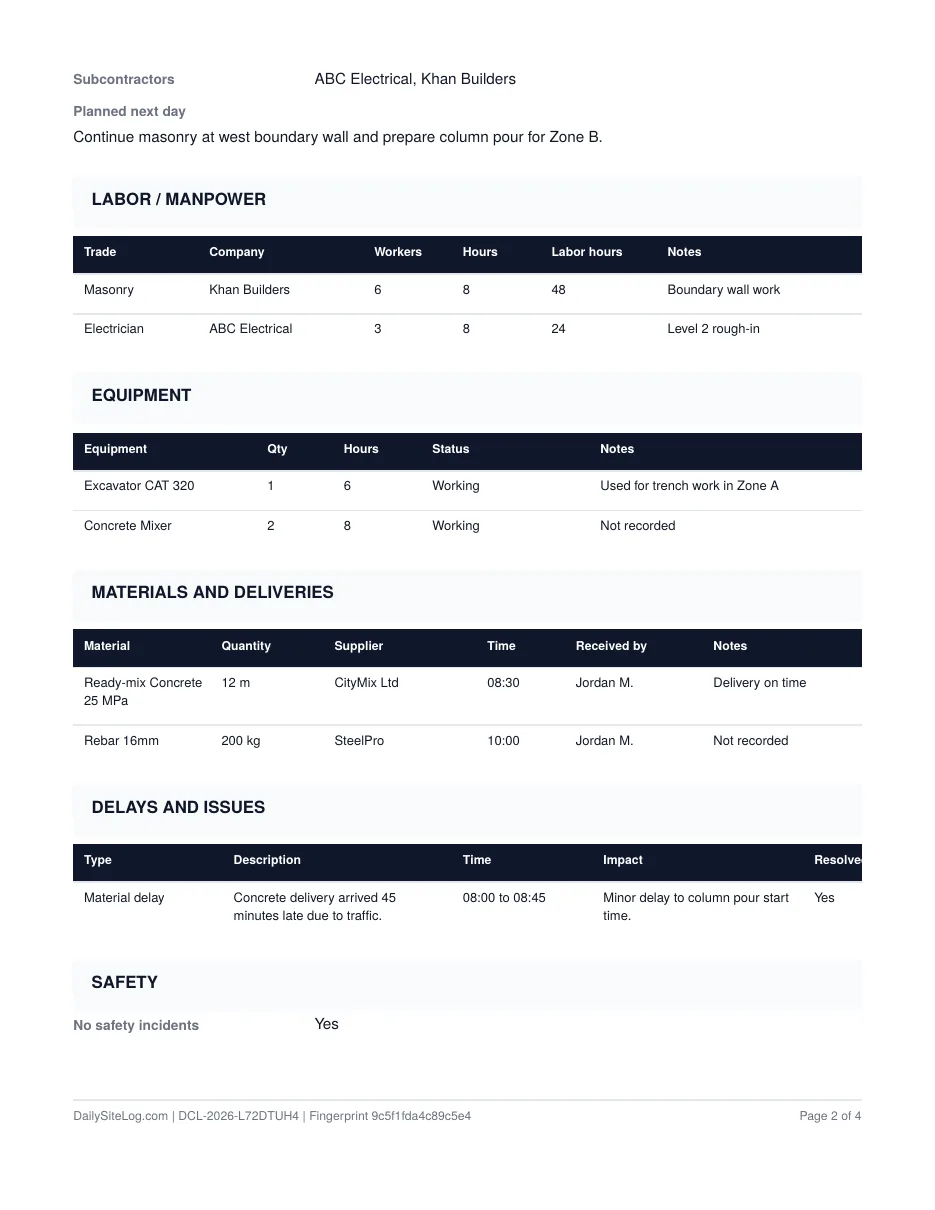
Owners deduct LDs when they think they can. A contractor who can produce a sealed daily report for each day it is claiming changes that conversation.
Daily Site Log records every delay with its type, times, impact and responsible party, stamps site photos with time and GPS, and seals each report when it is submitted so it cannot be edited later. Every delay on a project can be exported as one PDF for an extension-of-time claim. Start free or look at a sample report.
Sources
- Fenwick Elliott — Liquidated damages following Cavendish v Makdessi
- Herbert Smith Freehills — UK Supreme Court decision on penalty clauses
- Osborne Clarke — Cavendish v Makdessi: implications for construction contracts
- Restatement (Second) of Contracts §356; Paciocco v Australia and New Zealand Banking Group Ltd [2016] HCA 28
Frequently asked questions
How are liquidated damages calculated?
Multiply the daily (or weekly) rate in the contract by the number of days of delay the contractor is responsible for. That is the actual completion date minus the contract completion date, after adding any extensions of time granted. Many contracts also cap the total, often at a percentage of the contract sum.
Are liquidated damages the same as a penalty?
No. A penalty is a sum designed to punish the contractor rather than reflect the owner's interest in timely completion, and courts in the US, UK and Australia will not enforce one. Liquidated damages that were a fair estimate, or proportionate to a legitimate interest, are enforceable. Calling a clause 'liquidated damages' does not save it if it is really a penalty, and calling it a 'penalty' does not make it one.
Can an owner claim liquidated damages if it caused the delay?
Not for the delay it caused. If the contract has an extension of time mechanism, the completion date moves for owner-caused delay and LDs run only from the new date. If owner-caused delay cannot be dealt with under the contract, in the UK and Australia the 'prevention principle' can set time 'at large', which may leave the owner unable to claim LDs at all. US courts reach similar results through their own doctrines.
Do liquidated damages apply to subcontractors?
Only if the subcontract says so. Main contractors often pass liquidated damages down, sometimes at the same rate as the main contract. A subcontractor should check the rate, the cap, and whether it gets the same extension of time rights the main contractor has.
Can liquidated damages be more than the owner's actual loss?
Yes, if the clause is enforceable. The point of agreeing a figure in advance is that neither side has to prove actual loss later. An owner whose real loss turns out lower can still usually recover the agreed amount, and one whose loss turns out higher is usually limited to it.