What a toolbox talk is (and is not)
A toolbox talk is a short, informal safety briefing held on site, usually at the start of the shift, about one hazard that is relevant to the work being done that day or that week. The name comes from crews gathering around the toolbox before work. It is:
- Short. Five to fifteen minutes.
- Specific. One topic. "Ladders" not "safety".
- Relevant. Tied to today's work, today's weather, or something that went wrong yesterday.
- Two-way. The crew asks questions and raises concerns; those get recorded and acted on.
- Recorded. Topic, presenter, date, time, attendance with signatures.
It is not formal training, not an induction, and not a substitute for either. A worker who has never used a harness does not become competent through a ten-minute talk; a worker who is competent stays alert because of one.
Why the record matters as much as the talk
After an incident, the questions are always the same: was the worker trained on this hazard, when, by whom, and can you prove it? A stack of signed toolbox talk records answers all four. An unrecorded talk, for evidentiary purposes, did not happen.
The record also protects the crew. Questions raised in talks ("the edge protection on level 3 is loose") become documented concerns with an owner and a due date, instead of things someone mentioned once.
Two places the record should live:
- The talk record itself, with the attendance sheet, in the project safety file. The template above is one page.
- One line in that day's daily report: topic, presenter, headcount. This puts the talk in the chronological project record next to the weather, the crews and the work, which is where an investigator will look first.
How to run one that people listen to
- Pick the topic the night before, based on tomorrow's work, the weather forecast, and anything from yesterday's report (a near miss, a new sub starting, a delivery of heavy material).
- Stand where the hazard is. A talk about excavation safety given at the edge of the trench lands; the same talk in the site office does not.
- Open with a question, not a script. "What went wrong the last time someone used this saw?" gets attention; reading a sheet aloud loses it in thirty seconds.
- Three points maximum. The hazard, the control, what to do when the control is missing.
- Ask what they have seen. Record the answers. This is where the talk earns its time: crews know where the site is unsafe before supervisors do.
- Assign actions with names and dates. "Scaffold tag on the north elevation — Ahmed to check with the scaffolder today."
- Sign the sheet. Everyone. Print name, company, signature. Count heads and write the number.
- Log it in the daily report before you leave site.
40 toolbox talk topics, sorted
Pick by what is happening on site, not by what is next in a binder.
Always relevant
- Site induction refresher: rules, emergency assembly point, first aiders
- Housekeeping and trip hazards
- PPE: what is required in which zone, and why hi-vis is not optional at deliveries
- Manual handling and lifting
- Hand tools: inspection, guards, the right tool for the job
- Power tools and cords: GFCI/RCD, damaged leads, blade guards
- Slips, trips and falls on the level
- Reporting near misses without blame
- Mobile phones and distraction on site
- Fatigue, hydration and knowing your limits
Working at height
- Ladder selection, angle and three points of contact
- Scaffold tags, guardrails and never altering a scaffold
- Harnesses: inspection, anchor points, rescue plan
- Leading edges and floor openings: covers and barriers
- Roof work: fragile surfaces and skylights
- Mobile elevating work platforms: pre-use checks, ground conditions
Excavation and groundworks
- Trench collapse: shoring, benching, spoil placement
- Underground services: locates, hand digging near marks
- Confined spaces: when a trench becomes one
- Plant and pedestrians: exclusion zones and banksmen
Lifting and plant
- Crane lifts: exclusion zones, tag lines, never under the load
- Telehandler and forklift: load charts and visibility
- Rigging inspection: slings, shackles, damaged gear out of service
- Reversing vehicles and the blind spot
Electrical, fire and hot work
- Temporary electrics and overhead lines
- Lock-out / tag-out before working on any system
- Hot work permits and fire watch
- Fire extinguishers: types, locations, who is trained
- Flammable storage and gas cylinders
Weather and season
- Heat stress: shade, water, rest cycles, recognising symptoms
- Cold weather: layering, frostbite, icy access
- High winds: crane limits, sheet materials, scaffold boards
- Lightning: when to stop and where to go
- Wet weather: slippery surfaces, electrical risk, trench water
Health and hazardous materials
- Silica dust: wet cutting, extraction, RPE
- Asbestos awareness in refurbishment work
- Noise and hearing protection
- Hand-arm vibration from breakers and grinders
- Skin: cement burns and dermatitis
- Mental health on site: talking, and where to get help
For US sites, OSHA's Focus Four (falls, struck-by, caught-in/between, electrocution) should each come around at least monthly. For UK sites, CDM 2015 and the HSE's construction guidance cover the same ground under different names.
The one-line daily report entry
Every toolbox talk should produce a line like this in that day's report:
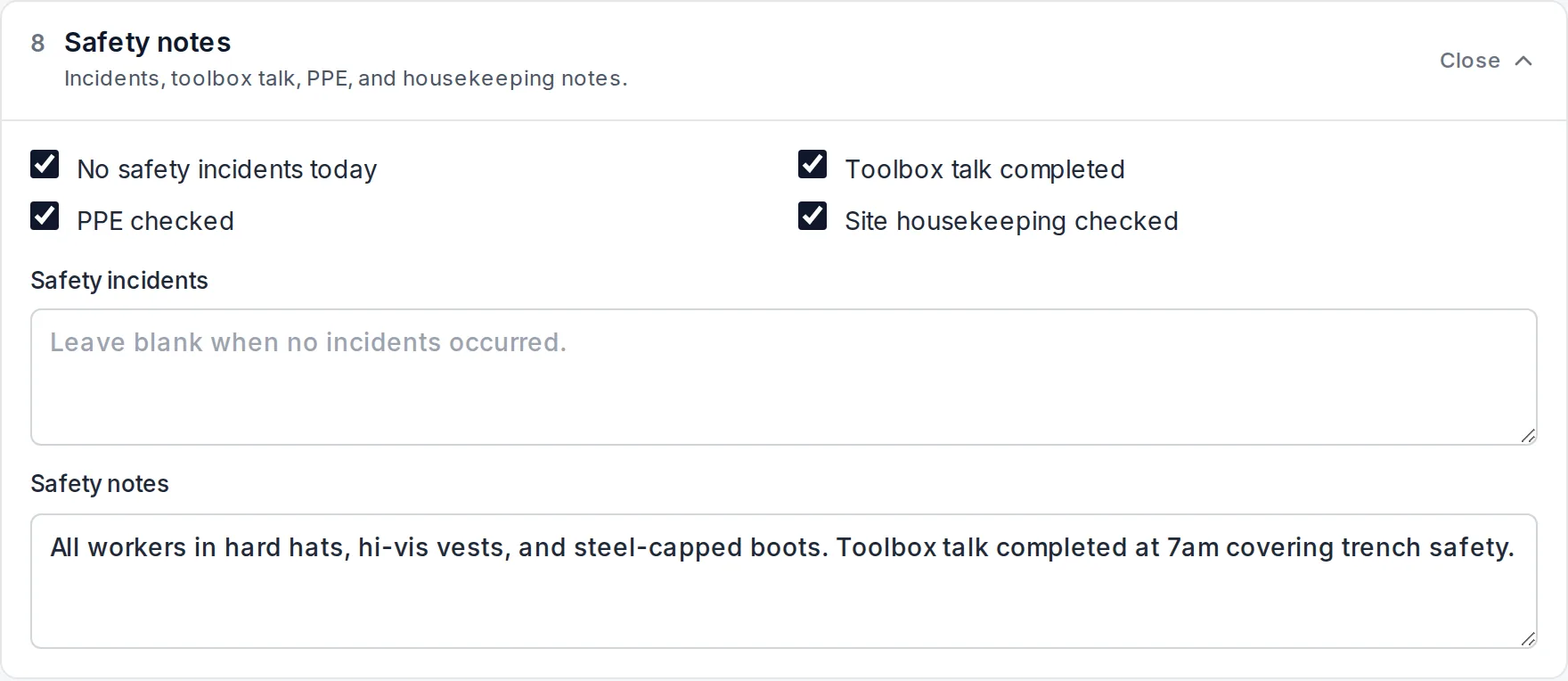
Toolbox talk 07:05–07:15, "Trench shoring and spoil placement", presented by M. Khan; 14 attending (own crew 9, Volt Electric 3, Metro Steel 2). Action: check trench box certification — S. Ali, today.
In Daily Site Log that goes in the safety notes section; on the Pro plan you can save it as part of a reusable safety template so the format is identical every day. On paper, the free daily report template has a safety block for it. Either way, the talk is now part of the day's record, dated and signed, next to the crews who heard it.
Common mistakes
- Reading a generic sheet. Crews switch off. Make it about this site, today.
- Same topic every week. Rotate by hazard and season; the list above is a start.
- No attendance sheet, or first names only. Print name and company, every time.
- Actions raised and forgotten. Write the owner and date; close them in the next talk.
- Talk not mentioned in the daily report. The safety file and the project record should agree.
- Only the GC's crew attends. Site-wide hazards need every company present.
- Forty minutes. That is training. Schedule it separately and keep the talk short.
Sources
- OSHA 29 CFR 1926.21(b)(2) — Safety training and education
- OSH Act Section 5(a)(1), the General Duty Clause
- OSHA Construction Focus Four training
- HSE — Construction (Design and Management) Regulations 2015
- HSE — Construction industry guidance
Frequently asked questions
How often should toolbox talks happen?
Weekly is the common minimum in contracts and safety programmes; daily is common on larger commercial and civil sites and whenever the work or conditions change (new trade starting, crane on site, heat wave). Short and frequent beats long and rare: five minutes every morning is absorbed; forty minutes once a month is not.
Are toolbox talks required by OSHA?
OSHA does not use the phrase 'toolbox talk' in a standard. It does require employers to train workers on the hazards of their work (for example 29 CFR 1926.21(b)(2) for construction) and to provide a workplace free of recognised hazards. Documented toolbox talks are the practical, widely accepted way to show ongoing training; in an inspection or after an incident, the signed records are what gets asked for. In the UK, HSE similarly expects information, instruction and training under the Health and Safety at Work Act and CDM 2015, and toolbox talks are the standard evidence.
How long should a toolbox talk be?
Five to fifteen minutes. One topic, one or two key points, a question or two from the crew, done. If it needs longer, it is training, not a toolbox talk, and should be scheduled as such.
Who should give the toolbox talk?
The person who supervises the work that day: the foreman or superintendent. Rotating the presenter among experienced crew members works well and improves engagement, as long as the supervisor is present and signs the record.
Do subcontractors need to attend the GC's toolbox talk?
Usually yes for site-wide topics (site rules, emergency procedures, crane operations, weather), and each subcontractor is also responsible for trade-specific talks for its own crew. Record which companies attended; the attendance sheet in the template has a company column for this reason.