
What a punch list is
Near the end of a project, someone walks every room with a clipboard or a tablet and writes down everything that is not finished, not right, or not what the drawings say. That list is the punch list. It exists because "substantially complete" and "actually complete" are different states, and money changes hands at each.
The name comes from the old practice of punching a hole next to each item on a paper list as it was fixed. The modern equivalent is a spreadsheet or an app with a status column, but the mechanics have not changed: a location, a deficiency, an owner, a date, a status, and a verification.
The list matters because of what hangs on it:
- Substantial completion is usually certified when the remaining work is limited to punch list items. That date starts warranty periods, stops liquidated damages, and often shifts insurance and utility responsibility to the owner.
- Final payment and retainage (typically 5–10% held back through the job) are released when the list is closed, or reduced by a multiple of the value of open items.
- The relationship. A short, specific, quickly closed list is how a contractor gets the next job. A long, vague, argued list is how they do not.
What belongs on it, and what does not
A punch list item is work that is in the contract and is incomplete, damaged, defective or not to specification. Typical items:
| Category | Examples |
|---|---|
| Incomplete work | Missing cover plates, unpainted trim, door hardware not installed |
| Damage | Scratched glass, dented door, chipped tile, gouged drywall |
| Not to spec | Wrong finish, wrong fixture model, grout colour does not match sample |
| Fit and function | Door rubs frame, window does not lock, drawer misaligned, outlet dead |
| Cleaning | Paint on hardware, labels on glass, construction dust in ducts |
| Documentation | Missing O&M manuals, warranties, as-builts, test certificates |
What does not belong: anything not in the contract, owner changes of mind, and items already on an open change order. Those go on a separate list titled accordingly. Mixing them holds up payment for the contractor and confuses the record for the owner.
Who writes it
| Project type | Pre-punch (contractor) | Formal list | Verification |
|---|---|---|---|
| Commercial, architect-administered | Superintendent walks with each trade; items fixed before requesting inspection | Architect / owner's rep after inspection | Architect |
| Residential / small commercial | Contractor walks alone first | Contractor and owner walk together, agree one list | Owner, or contractor with photos |
| Public works | Contractor pre-punch | Agency inspector | Agency inspector |
The single most useful habit is the pre-punch: walk the job as if you were the owner, list everything, fix it, and only then request the formal inspection. A formal walk that produces 12 items instead of 120 is a different conversation.
How to write items so they get closed
Vague items are the main reason lists drag. Each item needs enough detail that a tradesperson who was not on the walk can find it and fix it without asking.
Weak: "Fix paint in bedroom." Usable: "Unit 3B, Bedroom 2, west wall: 4 nail pops and roller marks above the window head; sand, fill, repaint wall corner to corner in specified colour (SW 7005). Photo P-031."
The fields in the template, and why each is there:
- Number. Sequential, never reused. Items are referred to by number in every email that follows.
- Location. Level, room or unit, grid or wall. Ambiguity here costs a return visit.
- Trade. So the item can be sorted and sent to the right subcontractor in one message.
- Item / deficiency. What is wrong and what "fixed" looks like.
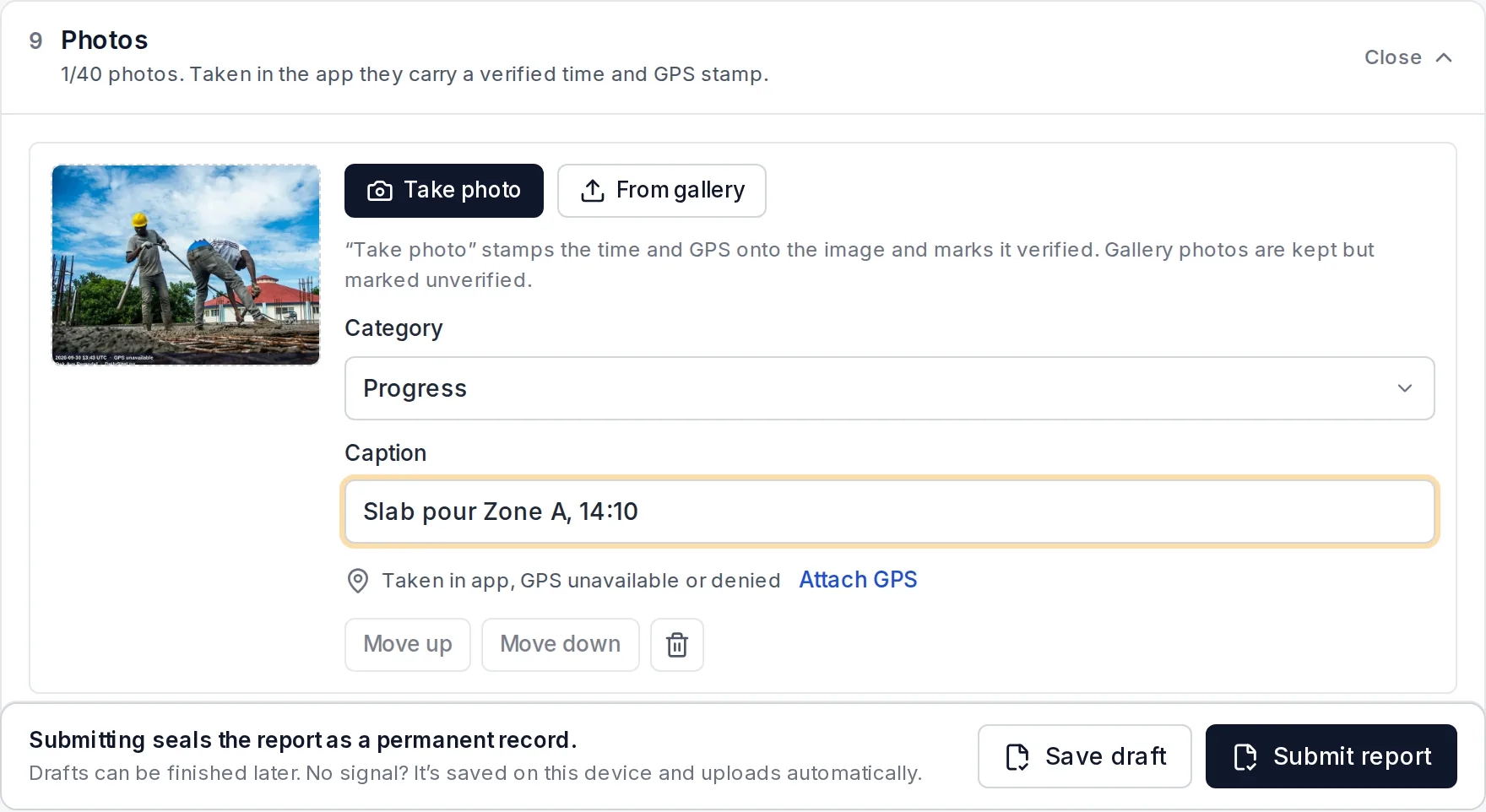
- Photo reference. A photo taken on the walk, numbered. Photos settle "that was already like that" arguments.
- Responsible. The subcontractor or crew, by company name.
- Priority. H = safety or blocks handover; M = must be done before final; L = cosmetic. Owners accept a few open L items; they will not accept an open H.
- Issued / due. The due date is negotiated on the walk, not imposed later.
- Status. Open, In progress, Complete, Verified, Disputed. Complete is the contractor's claim; Verified is the owner's acceptance. Only Verified counts.
- Verified by / date. The signature that releases the money.
The process that actually closes lists
Two weeks before you expect substantial completion
- Superintendent walks each area with the relevant trade foreman. Everything found is fixed before the formal walk. Use the printable PDF template on the walk.
- Confirm the paperwork side: O&M manuals, warranties, test reports, as-builts, keys. Missing documents are punch items too and take longer than paint.
The formal walk
- Walk in a fixed order (top floor down, or room by room clockwise) so nothing is skipped and the numbering follows the building.
- One person writes; everyone agrees the wording of each item on the spot. Photograph every item.
- Agree due dates and the verification method before anyone leaves. Agree what happens to items that depend on supplier lead times.
After the walk
- Transfer the list to the Excel template the same day. Sort by trade and send each subcontractor their items with photos, due dates and the return-visit schedule.
- Track it daily. The daily report for the closeout period should record which punch items were worked on, by whom, and which were completed. That log is your evidence when the owner says items were not addressed.
- Re-walk only completed items, with the person who raised them. Move to Verified with their initials and the date.
- Send the closed list with the request for final payment.
The daily report during punch
The closeout weeks are when documentation usually gets thin: the big crews are gone, the superintendent is on two other jobs, and nobody files a report because "nothing happened". Something did happen: three items were fixed, one supplier confirmed a ship date, the owner's rep verified 14 items. Record it. A punch period with daily reports showing steady closure is a strong position when retainage is being withheld; a punch period with no reports is the owner's argument.
In Daily Site Log the work-performed section takes the item numbers ("Punch items 14, 15, 22 complete, Unit 3B"), the photo section holds the after photos, and delays that stop punch work (a late fixture, an owner decision) go in the delay row with the responsible party. On paper, the free daily report template has the same sections.
Common mistakes
- No pre-punch. The formal list is long, the owner's confidence drops, and the closeout stretches for months.
- Vague items. "Touch up paint throughout" is not an item; it is an invitation to disagree.
- No photos. Without a before photo, "that was already damaged" cannot be settled.
- Marking items Complete without verification. The owner walks, finds half of them still open, and stops trusting the status column.
- Scope creep on the list. Owner requests that were never in the contract belong on a change-order list, not the punch list.
- No daily record during closeout. The period when payment is most at risk is the period least documented.
- One list for the whole building. Sort by trade and by area; each sub should receive only their items.
Punch list vs snag list vs defects list
Same document, three names:
| Term | Where | Notes |
|---|---|---|
| Punch list | US, Canada | AIA A201 ties it to substantial completion |
| Snag list / snagging | UK, Ireland | Often followed by a 12-month defects period under JCT |
| Defects list | Australia, NZ, FIDIC contracts | "Defects liability period" runs from practical completion |
If you work across regions, keep the column headings in the template and change only the title.
Sources
- AIA A201-2017 General Conditions of the Contract for Construction
- JCT contracts
- FIDIC Conditions of Contract (bookshop)
Frequently asked questions
Who creates the punch list?
On most commercial projects the architect or owner's representative prepares the formal list after the contractor requests a substantial-completion inspection, but the contractor should walk the job first and produce its own pre-punch list so the formal walk finds little. On residential and small commercial jobs the contractor and owner often walk together and one list is agreed on the spot. Whoever writes it, the contractor is responsible for closing it.
What is the difference between a punch list and a snag list?
Nothing, apart from geography. Punch list is the US and Canadian term; snag list (or snagging list) is used in the UK and Ireland; defects list or defects liability list is common in Australia, New Zealand and under FIDIC-style international contracts. The process is the same: itemise, assign, fix, verify, sign off.
When is the punch list done?
When every item has been fixed and verified by the person who raised it, not when the contractor says it is fixed. Most contracts tie final completion and the last payment, including retainage, to a signed-off punch list; some allow the owner to hold back a multiple of the estimated value of open items instead. Agree the verification method before the walk.
How long should a punch list take to close?
Contracts commonly allow 30 days from substantial completion, sometimes 14 for smaller projects. Items that depend on a supplier (a replacement pane, a special-order fixture) should have their own realistic dates recorded, with the order confirmation attached, so a single late part does not make the whole list look overdue.
What should not be on a punch list?
Work that was never in the contract, changes the owner has since decided they want, and items already covered by an open change order. Those are variations, not deficiencies. Politely move them to a separate list; a punch list padded with scope creep delays payment for everyone.