
What an RFI is, and what it is not
Contract documents are never complete. Drawings conflict with schedules, a dimension is missing, the spec names a product that is discontinued, or the ground turns out not to be what the borehole log said. When that happens the contractor cannot guess; guessing wrong is at the contractor's cost. The request for information is the formal mechanism for asking, and for putting the answer on the record.
An RFI is:
- Written and numbered, sequential per project.
- Addressed through the contractual chain: sub to GC, GC to architect/engineer, sometimes via the owner's representative.
- Specific: it cites the drawing, detail, spec section and location, and asks one question.
- Time-bound: it states when a response is needed and why.
- Logged, with the date issued, the due date, the date answered and the outcome.
An RFI is not a change order. It does not authorise extra work or extra time. If the response changes the scope, the next document is a change order request, a variation, or a compensation event, depending on the contract. Contractors lose money by treating "yes, use the 6-#6 bars" as permission to install and invoice; it is permission to install, and the invoice still needs the change order.
When to raise one
Raise an RFI when the answer affects cost, time, quality or safety and is not already in the documents. Typical triggers:
| Trigger | Example |
|---|---|
| Conflict between documents | Column schedule says 6 bars; the section detail shows 4. |
| Missing information | No dimension for the opening; no finish specified for the stair soffit. |
| Unclear or ambiguous requirement | "Match existing" where the existing varies. |
| Unavailable product | Specified fixture discontinued; propose an equal. |
| Site condition differs from documents | Rock at 1.2 m where boreholes showed clay to 3 m. |
| Design intent question | Waterproofing detail does not show a termination at the door threshold. |
| Coordination clash | Duct route passes through the beam shown on the structural drawings. |
Do not raise an RFI for things the documents already answer, for questions a phone call resolves with no cost or time consequence, or to shift a decision that is contractually yours. RFI volume is read by owners as a measure of the design quality and of the contractor's diligence; a stack of trivial RFIs damages both.
How to write an RFI that gets answered
Designers answer clear RFIs first. The format that works:
Header. Project, RFI number, date, from, to, discipline, spec section and drawing reference, location (level, grid, room), response required by, and a checkbox for whether cost or schedule are at risk.
Question. One question, stated precisely, quoting the documents. Bad: "What size rebar in the columns?" Good: "S-201 detail 4 shows 4-#6 vertical bars in columns C4–C9 at Level 2; the column schedule on S-001 shows 6-#6 for the same columns. Please confirm which governs."
Proposed solution. Offer the answer you would accept, and say what happens if the response is late. "We propose to proceed per the schedule (6-#6) as the conservative case. Rebar placement is scheduled for 14 October; a response after 10 October will delay the Level 2 pour." A designer can approve a good proposal in one line. Without it, they have to research the answer, and your RFI goes to the bottom of the pile.
Attachments. A marked-up drawing extract, photos with date and time, and the daily report number where the issue was first noted.
Response block. Space for the answer, who gave it and when, whether it changes cost or time, and distribution.
The template above follows this structure.
The RFI process, step by step
- Identify the gap on site or during coordination. Note it in that day's daily report with the location and the work it affects.
- Check the documents and prior RFIs; the answer may exist.
- Draft the RFI with a proposed solution and a due date tied to the schedule.
- Number and log it. The log is the master list; the RFI is the document.
- Issue through the contractual channel, by the method the contract specifies (email, portal, letter).
- Chase at the halfway point and the day before the due date. Politely, in writing.
- Receive and distribute the response to everyone who needs it: subs, the field, the estimator.
- Assess impact. If the response changes scope, cost or time, raise the change order request or variation notice within the contract's period.
- Close the RFI in the log with the date, outcome and any linked change order.
Response times and what to do when they slip
Seven to ten working days is the norm written into many contracts and recommended by industry bodies; public contracts often allow longer. Put the due date on the RFI and in the log, and make the schedule consequence explicit in the proposed-solution paragraph.
When a response is late and work is affected, the RFI becomes a delay event. From that day:
- Log a delay row in the daily report: type Drawing/RFI issue, the RFI number, what work is stopped or resequenced, hours or crews affected, responsible party (designer/owner).
- Photograph the stopped work front.
- Send written notice of delay if the contract requires it (most do, with short clocks; see how to document delays so the claim holds for the notice mechanics).
- Keep the entry going every day until the response arrives and work resumes.
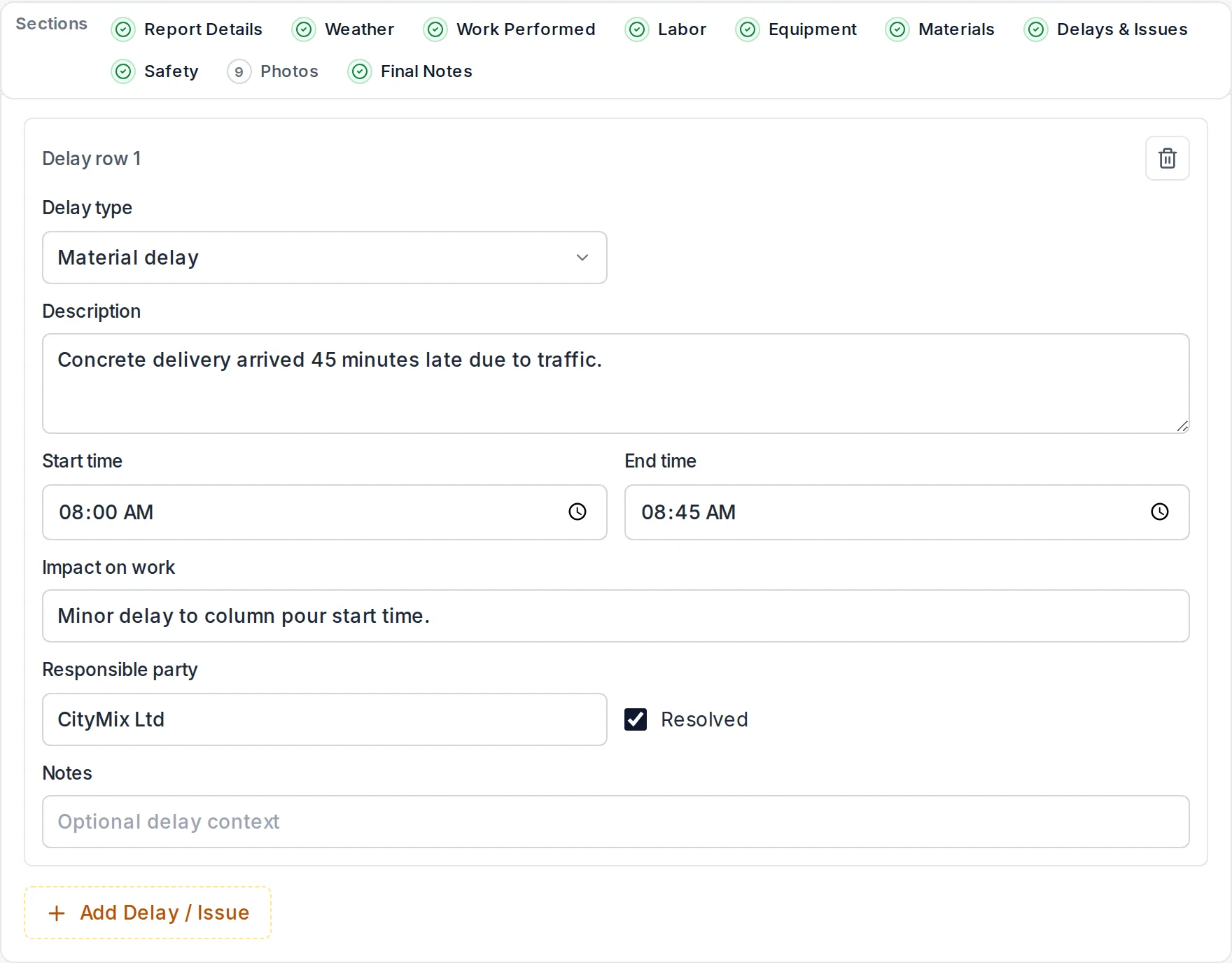
An RFI that stopped work for eleven days, recorded only in an email chain, is an argument. The same RFI with eleven daily reports each showing the stopped activity, the idle crew and the number is a claim.
Keeping the log
The log is the document owners and lawyers ask for. One row per RFI:
RFI number · date issued · subject · drawing/spec reference · addressed to · response due · date answered · days open · status · schedule impact · cost impact · change order reference · daily report reference · notes.
The Excel log in the downloads calculates days open and has a status drop-down (Open, Answered, Closed, Superseded). Review it in the weekly meeting; anything open past its due date is an agenda item with a name next to it.
Two habits make the log worth keeping. First, link every RFI to a daily report number so the field record and the correspondence record point at each other. Second, close the loop to the change order: the log should show which RFIs produced which change orders, because that is the story of where the money went.
Common mistakes
- Multiple questions in one RFI. Each gets answered on the slowest one's timeline. One question per RFI.
- No proposed solution. Forces the designer to do the work; slows the answer.
- No due date, or one not tied to the schedule. Nobody is late answering an RFI with no date.
- Raising it by phone and confirming nothing. The answer is not on the record and the delay clock never started.
- Treating the response as a change order. Extra work done, never paid.
- Subcontractors issuing directly to the designer. Breaks the chain; the GC does not know what was asked or answered.
- Not logging the impact on the day. The daily report is where the delay is proven; the RFI is only where it started.
Where the daily report fits
The RFI system and the daily report are two halves of the same record. The RFI captures the question and the answer; the daily report captures what it did to the site, day by day. A tool that records delays as a type, times and a responsible party makes the second half automatic. Daily Site Log does this on its free plan; a paper template does it if you fill in the delay row every day. Either way, the RFI number goes in the report the day the issue is found, and every day it costs you.
Sources
- AIA A201-2017 General Conditions of the Contract for Construction
- ConsensusDocs 200 Standard Agreement and General Conditions
- Navigant Construction Forum, "Impact & Control of RFIs on Construction Projects" (2013) — the source of the ~800 RFIs per project and ~10 per $1M figures cited in the FAQ (report distributed by Navigant, now Guidehouse; not reliably available at a stable URL)
- Procore support — Daily Log
Frequently asked questions
How long should it take to respond to an RFI?
Most contracts and industry guidance set 7 to 10 working days; some public contracts allow 14 to 21 calendar days. Urgent RFIs affecting work in progress should say so and request a shorter turnaround. Track the due date on the RFI itself and in the log; an RFI with no due date is a question nobody is late answering.
Who can issue an RFI?
Normally the general contractor issues RFIs to the architect or engineer of record, on behalf of itself and its subcontractors. Subcontractors send their questions to the GC, who consolidates and numbers them. Sending RFIs directly from a sub to the designer usually breaks the contractual chain and the record.
Does an RFI change the contract?
No. An RFI is a request for clarification. If the response requires work beyond the contract documents, or more time, the contractor must then request a change order (or notify a variation / compensation event under UK and international forms). Treating an RFI response as authorisation for extra work is one of the most common ways contractors do unpaid work.
What is the difference between an RFI and a submittal?
An RFI asks the designer a question. A submittal shows the designer what you intend to install (shop drawings, product data, samples) for review. Both are formal, numbered and logged, but they run in opposite directions: an RFI seeks information, a submittal provides it for approval.
How many RFIs are normal on a project?
Studies of large commercial projects have found averages on the order of 800 to 1,000 RFIs per project and roughly 10 per million dollars of construction cost, with each costing over a thousand dollars in staff time to process. Small projects see far fewer, but the per-RFI cost is the point: an RFI that could have been a 30-second conversation should be a conversation, and one that changes cost or time must be an RFI.