
Short version
Most delay claims are not lost on the law. They are lost on records. When the owner or GC asks "which days, how long, who was idle, and why?", the party with a complete run of same-day daily reports usually wins.
This guide is general information, not legal advice. Your contract governs; for a large claim, talk to a construction lawyer or claims consultant.
Types of delay
| Type | Who is responsible | What you can usually recover | Examples |
|---|---|---|---|
| Excusable, non-compensable | Nobody (neutral event) | Time only | Unusually severe weather, strikes, some force majeure events |
| Compensable | Owner, GC or their agents | Time and money | Late drawings or approvals, changes, no access, owner-supplied materials late |
| Non-excusable | You | Nothing (you may owe liquidated damages) | Your crew short, your supplier late, your rework |
| Concurrent | Both parties at once | Depends on contract and jurisdiction | Late access and your own crew shortage on the same days |
How a delay is classed depends on your contract's wording. See construction delays for causes and liquidated damages for what happens on the other side.
The four things every claim must prove
- Event: what happened, on which dates, from what time to what time.
- Cause and responsibility: who or what caused it, and that it was not your risk under the contract.
- Effect on time: that it delayed critical work or the completion date, not just a task with float.
- Quantum: how many days, and what it cost: idle labour hours, standing equipment, extended site overheads.
Daily reports carry points 1 and 2 almost entirely, and provide the raw data for 3 and 4.
Delay analysis, in plain words
| Method | What it does | When it fits |
|---|---|---|
| As-planned vs as-built | Compares the original schedule to what actually happened | Small and medium claims with good daily records |
| Impacted as-planned | Adds the delay events to the original schedule | Quick estimates; criticised for ignoring what actually happened |
| Time impact analysis (TIA) | Inserts each delay into the schedule update current at the time | Prospective extension-of-time requests; commonly expected on larger jobs |
| Windows analysis | Reviews the schedule month by month (or by window) | Long projects with many overlapping delays |
Whichever method is used, it is only as good as the record of what happened each day.
The daily records that win claims
For every delay, on the day it happens, record:
- Type of delay (weather, late material, no access, design information, inspection, other trade, change)
- Start and end time: "07:30–11:00", not "morning"
- What stood idle: crew by trade and headcount, equipment by name
- Impact: labour hours and equipment hours lost
- Responsible party, in plain words
- Notice: who you told, how, and when
- Photos taken in an app that stamps time and GPS, so nobody can argue when they were taken
Then send the report to the GC or owner that day. A dated report in their inbox doubles as written notice in many cases. Follow your contract's notice clause exactly.
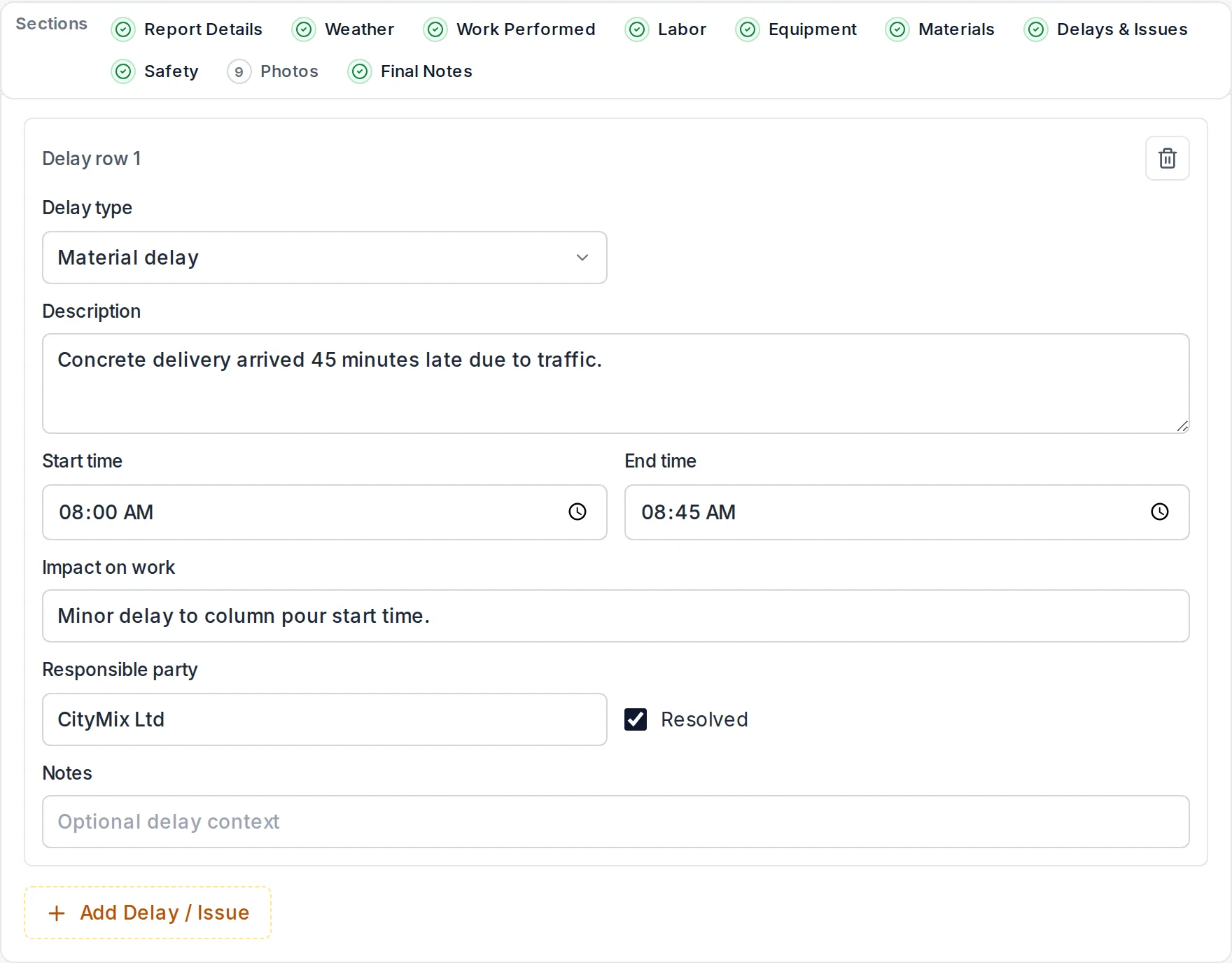
From daily records to a claim pack
- Pull every delay for the period from your daily reports.
- Group by cause and responsible party.
- Total the hours: idle labour by trade, standing equipment, extra supervision.
- Line it up against the schedule: which activities moved, and did completion move?
- Attach the evidence: the daily reports, photos, notices and correspondence.
Daily Site Log does steps 1 to 3 for you. Every delay is a structured record in a sealed daily report, and one click exports a project delay PDF with dates, times, causes, responsible parties and linked photos. Start free, or read how to document delays from your phone.
Common mistakes
- Missing the notice deadline. The most common way good claims die.
- Vague entries: "waiting on drywall" proves almost nothing.
- Reconstructing records weeks later. Same-day records carry much more weight.
- Gaps in the record. A complete run of reports, including quiet days, makes the bad days believable.
- Ignoring your own delays. Concurrent delay arguments are won by honest records, not by leaving things out.
Sources
- Society of Construction Law Delay and Disruption Protocol
- Fenwick Elliott — The SCL Delay and Disruption Protocol: a second edition
- AACE International Recommended Practice 29R-03, Forensic Schedule Analysis
- Daily Site Log pricing
Frequently asked questions
What is the difference between excusable and compensable delay?
An excusable delay is one the contractor is not responsible for, so it usually earns extra time but not money, for example unusually severe weather where the contract treats it that way. A compensable delay is caused by the owner or its agents, such as late drawings, changes or no site access, and usually earns both time and money. A non-excusable delay is the contractor's own responsibility and earns neither. Your contract's wording decides which applies.
How long do I have to give notice of a delay?
It depends on the contract. Many standard forms require written notice within a short period, often 7 to 21 days of the event or of when you became aware of it, and some say a late notice loses the claim. Check the notice clause in your contract and send written notice the same day where you can.
What is delay analysis?
Delay analysis is how the delay's effect on the completion date is measured. Common methods are as-planned vs as-built comparison, impacted as-planned, time impact analysis (inserting the delay event into the schedule at the time it happened) and windows analysis (reviewing the schedule period by period). Large claims usually use a scheduling expert; small claims often rely on a clear as-planned vs as-built comparison backed by daily records.
Can a subcontractor make a delay claim?
Yes, normally against the party it contracts with, usually the general contractor, under the subcontract's terms. Subcontractors are often hurt most by poor records, because the GC's daily log tells the GC's version. Keep your own daily report and send it to the GC daily.
What records do I need for a delay claim?
Daily reports showing the delay each day it happened (cause, start and end time, crew and equipment idle, responsible party), the baseline and updated schedules, written notices and correspondence, photos with time and location, delivery records, and cost records for idle labour and equipment.