
Short version
A daily log book is the simplest daily record there is: one page per day, written on site, signed at the end of the shift. It costs nothing, needs no signal, and still holds up when kept properly.
Download the free printable version below. Then, if you are tired of retyping it, losing pages or digging for photos, look at the phone option at the end.
We make Daily Site Log, a daily report app, so we have an opinion on paper versus phone. The printable book is free either way.
Free printable construction daily log book
The PDF has a cover page for the project details, one page of rules for keeping the log, and 31 daily pages, one per day, US Letter size. Each daily page has:
- Date, day, report number and shift hours
- Weather morning and afternoon, temperature, and hours lost to weather
- Crew on site: company or trade, number of workers, hours, work performed and location
- Equipment: who owns or supplied it, hours used, idle or broken and why
- Deliveries: material, supplier, quantity, and anything short or rejected
- Delays and problems: what stopped work, the responsible party, time lost, who was told
- Visitors, inspections and instructions received
- Safety: incidents or near misses
- Notes, and a signature with the time
Download the construction daily log book (PDF)
Print it double-sided and have it spiral-bound, or keep loose pages on a clipboard and file them in order each week. Bound is better: it is harder to remove or insert a page later.
What to write each day
The test for every line: would someone who was not there understand what happened, who did it and how long it took?
- Who was on site. Every company, how many people, how many hours. Include subs and suppliers who delivered.
- What got done, and where. "Formed and poured footings gridlines A–C" beats "concrete work".
- Equipment. What was used, who supplied it, and anything that sat idle or broke down. Idle plant is money someone will argue about.
- Deliveries. What arrived, from whom, and whether it was short, damaged or late.
- Delays. What stopped or slowed work, which company was responsible, and how much time was lost. This is the line that decides delay claims.
- Visitors and instructions. Inspectors, the owner, the architect, and any instruction given verbally. Write down who said what.
- Weather. Not just "rain": when it started, and what it stopped.
- Safety. Incidents, near misses, toolbox talks held.
For delays caused by weather, our guide to documenting weather delays covers what to record so the time is recoverable.
Rules that make a paper log hold up
A log book is only as good as the habits behind it:
- Same day, on site. A log written on Friday for the whole week is weak evidence.
- Ink, never erased. Strike through mistakes with one line, then initial and date the correction.
- Every page in order. No torn-out pages. On a working day with no work, write "No work" and why.
- Facts, not opinions. "Electrician absent, 3 hours lost on ceiling close-up" rather than "electrician unreliable".
- Signed daily. By the person who saw the work.
- Back it up. Photograph each finished page. A soaked or lost book takes your record with it.
Paper log book or phone app?
Paper works. It also has real limits, and most contractors hit them on their second or third job:
| Paper log book | Phone app | |
|---|---|---|
| Cost | Free to a few dollars | Free to a monthly fee |
| Works with no signal | Yes | The good ones do |
| Search for "the day the pump broke" | Page by page | Seconds |
| Photos with the entry | No, they live on a phone | Yes, stamped with time and location |
| Send to the client | Scan or retype | PDF in one tap |
| Proof it was not changed later | Bound book, ink | Sealed record with a fingerprint |
| If lost or damaged | Gone | Stored online |
If you only need a record for yourself, paper is fine. If you send reports to a client, chase delay claims, or have more than one site, a phone app usually saves an hour a day of retyping.
The same log on your phone
Daily Site Log keeps the same fields as the printable book: crew, equipment, deliveries, delays with the responsible party, visitors and safety. The difference:
- Talk instead of write. Speak for a minute at the end of the day and the report fills itself in (Pro and Business).
- Photos stamped with time and GPS when taken in the app.
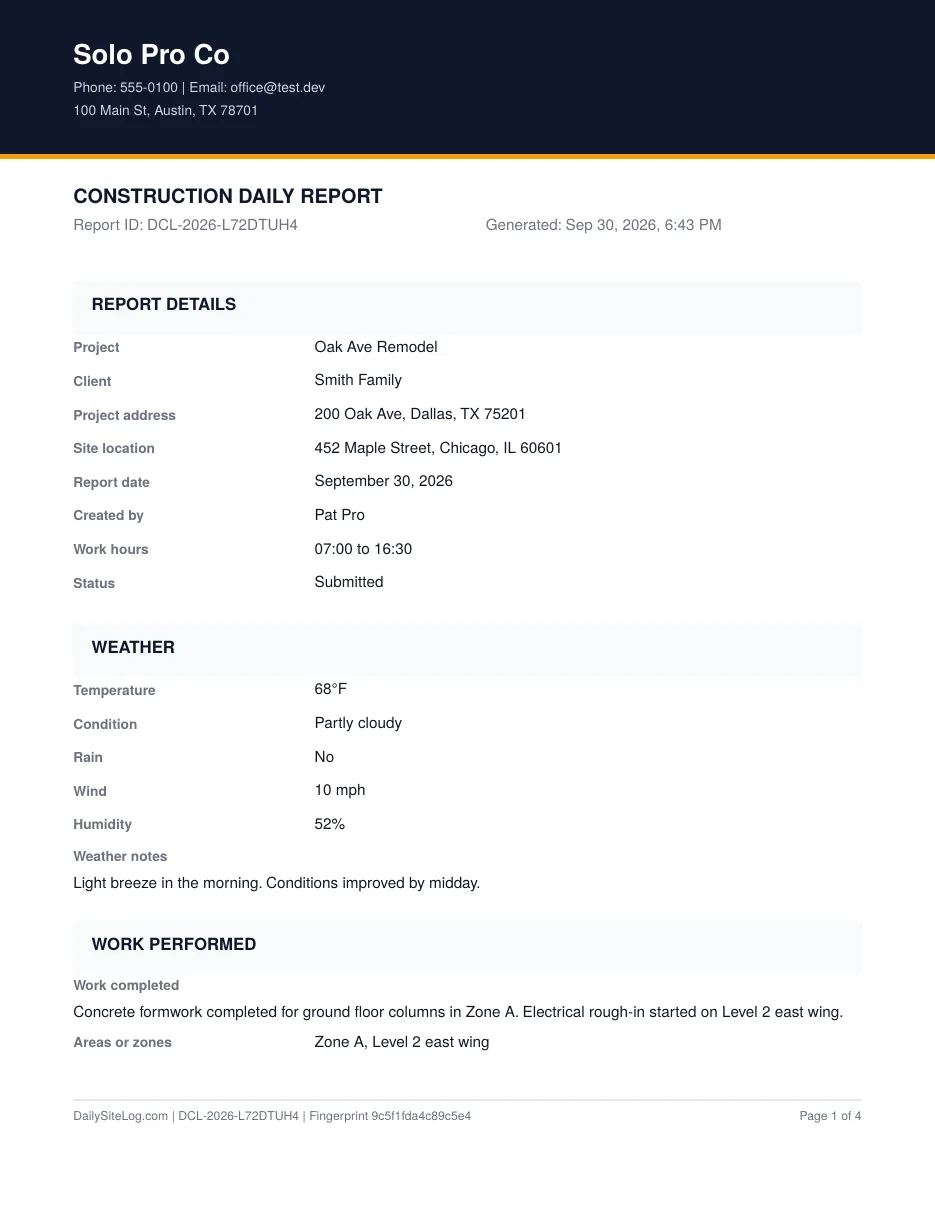
- A signed PDF for the client, sealed so they can check it was not edited: see a sample report.
- Works with no signal and sends when the phone is back online.
- Free for one project and ten reports a month; $19 a month for unlimited.
Sources
Frequently asked questions
Is a paper construction log book still legally valid?
Yes, a paper log is a valid business record if it is kept properly: bound, in ink, written the same day, signed, in page order, with corrections struck through rather than erased. Its weakness is practical, not legal: it cannot be searched, photos live somewhere else, and a lost or damaged book is gone. This is general information, not legal advice.
Who should keep the daily log book?
The person in charge on site who saw the work, usually the superintendent or foreman. If someone else writes it up, the person who observed the work should check and sign it the same day.
What is the difference between a daily log book and a daily report?
Mostly where it lives. A log book is the bound record kept on site; a daily report is the same information sent to the owner or project manager. Many contractors keep both: a candid log for themselves and a formal report for the client. Our daily log vs daily report guide explains the terms.
Where can I buy a construction daily log book?
Bound log books are sold by office supply stores and online marketplaces. You can also print the free PDF on this page and have it spiral-bound at a print shop, which costs a few dollars.
How long should a construction daily log book be kept?
At least the records-retention period in your contract, commonly three to seven years after final payment, and ideally as long as claims can be brought where the project is, which can be longer for defects.