
Five names, one document
Ask a US superintendent, a UK site manager and a Pakistani site engineer what they fill in at the end of the day and you get three answers: a daily log, a site diary and a DPR. Ask their clients what they receive and you get a fourth: the daily report. They are describing the same thing.
| Term | Used mainly in | Typical connotation |
|---|---|---|
| Daily log | US, Canada (field staff) | The superintendent's own record; historically a bound paper log book |
| Daily report / daily construction report | US, Canada (owners, software, contracts) | The formal document submitted to the owner or kept for the project file |
| Site diary | UK, Ireland, Australia, NZ | Site manager's daily record; a standard requirement under JCT and NEC forms |
| Daily progress report (DPR) | India, Pakistan, Bangladesh, Gulf | Emphasis on quantities executed against the BOQ and cumulative percentage |
| Superintendent's / foreman's daily log | US | Same as daily log, naming the author |
The regional differences are real but small: a site diary tends to record visitors, instructions received and weather in more detail; a DPR tends to record quantities; a US daily report tends to be structured around labour hours by trade. A well-designed record covers all of it. If you work under UK or Australian contracts, our site diary guide covers what to record each day and has a free printable A4 template.
If you keep a paper log, our free printable construction daily log book has 31 daily pages with every field below.
Where the terms actually differ: contract definitions
The only place the distinction costs money is where a contract uses two terms for two different obligations. Three patterns show up.
1. Log kept vs report submitted. Some contracts require the contractor to keep a daily log on site, available for inspection, and separately to submit a daily or weekly report to the owner. The log is the raw record; the report is the deliverable. If you are keeping only one, keep the one that would satisfy both: complete enough to be the log, formatted well enough to be the report.
2. Personal notebook vs project record. Superintendents often keep a private log with candid notes ("owner's rep changed his mind again") alongside the formal report. That is fine as long as everyone understands that in a dispute both are discoverable. Write the private log as if the owner's lawyer will read it, because they may.
3. Named formats. Public agencies frequently prescribe a form (a state DOT "Inspector's Daily Report", a federal "Contractor's Daily Report"). Where a form is prescribed, use it; supplement it with your own record if the form omits something you need, such as delay attribution.
What the main standard forms say
| Form | What it requires | Practical reading |
|---|---|---|
| AIA A201 (US) | Contractor to keep records available to the owner; the specifications (often Division 01) add the daily report requirement, usually with content and submission timing | Read Division 01 "Project Management and Coordination" / "Construction Progress Documentation"; the daily report spec is normally there |
| ConsensusDocs 200 (US) | Similar: records available; daily reports where the contract documents require | Check the owner's supplementary conditions |
| JCT (UK) | No express "site diary" clause, but records are needed to support extension of time and loss/expense claims; the site diary is the universal practice | Keep it daily; JCT claims fail without contemporaneous records |
| NEC3/NEC4 (UK) | Early warnings, compensation events and the accepted programme all rely on records; some Works Information/Scope prescribes a daily site diary | If the Scope names a diary format, use it |
| FIDIC (international) | Sub-Clause 6.10 (Records of Contractor's Personnel and Equipment) requires daily records of personnel and equipment on site, submitted to the Engineer; plus records for claims under Clause 20 | The personnel/equipment record is mandatory daily; the rest is prudence |
The pattern: contracts rarely say "keep a daily log". They say "keep records", then make your claims depend on having them. The daily log is how everyone satisfies that.
Paper log book vs spreadsheet vs app
People searching for "construction daily log book" usually find bound paper books for sale. They still have a place, and they still have limits.
| Bound paper log book | Word/Excel template | Purpose-built app | |
|---|---|---|---|
| Tamper evidence | Good (bound, ink, sequential) | Poor (file dates prove nothing) | Good if reports are sealed/hashed after submission |
| Searchable | No | Partly | Yes |
| Photos attached | No | Manually | Automatically, with time and location |
| Multiple readers | No | Yes | Yes, with roles |
| Weather source | Manual | Manual | Automatic for the site address |
| Cost | $15–40 per book | Free (template) | $0–79/month flat, or per user |
| Fails when | Book is lost or damaged | Someone skips days or edits later | Phone is dead and the app does not work offline |
A bound book kept honestly is better evidence than a spreadsheet edited carelessly. An app that seals each report and stamps each photo is better than both, provided it works offline and the crew actually uses it.
One record that satisfies all of them
Whatever it is called, the record needs the same content. The ten sections below cover a US daily report, a UK site diary and a South Asian DPR at once; the full breakdown with examples is in the daily report guide.
- Report details (project, date, number, author, hours)
- Weather and its effect on work
- Work performed, by location, plus quantities if your contract or your DPR format wants them
- Labour by trade and company, with hours
- Equipment used and idle
- Materials and deliveries
- Delays and issues, with times and responsible party
- Safety: toolbox talk, incidents, inspections, visitors and instructions received
- Photos, captioned
- Notes and sign-off
Two additions make the record work internationally. First, visitors and verbal instructions with times: UK site diaries have always recorded these, US reports often skip them, and they are decisive when an owner's representative later denies giving an instruction. Second, quantities: a column for "quantity executed today / cumulative" alongside the work-performed lines satisfies DPR-style reporting and makes monthly valuations easier everywhere.
Which term to use in your own documents
Use the term your contract uses. If the contract is silent, use "daily report" for anything you issue to the client and "daily log" or "site diary" for the on-site record, and make them the same document. Name the file consistently (ProjectCode_DailyReport_2026-10-01) so a year of records sorts itself.
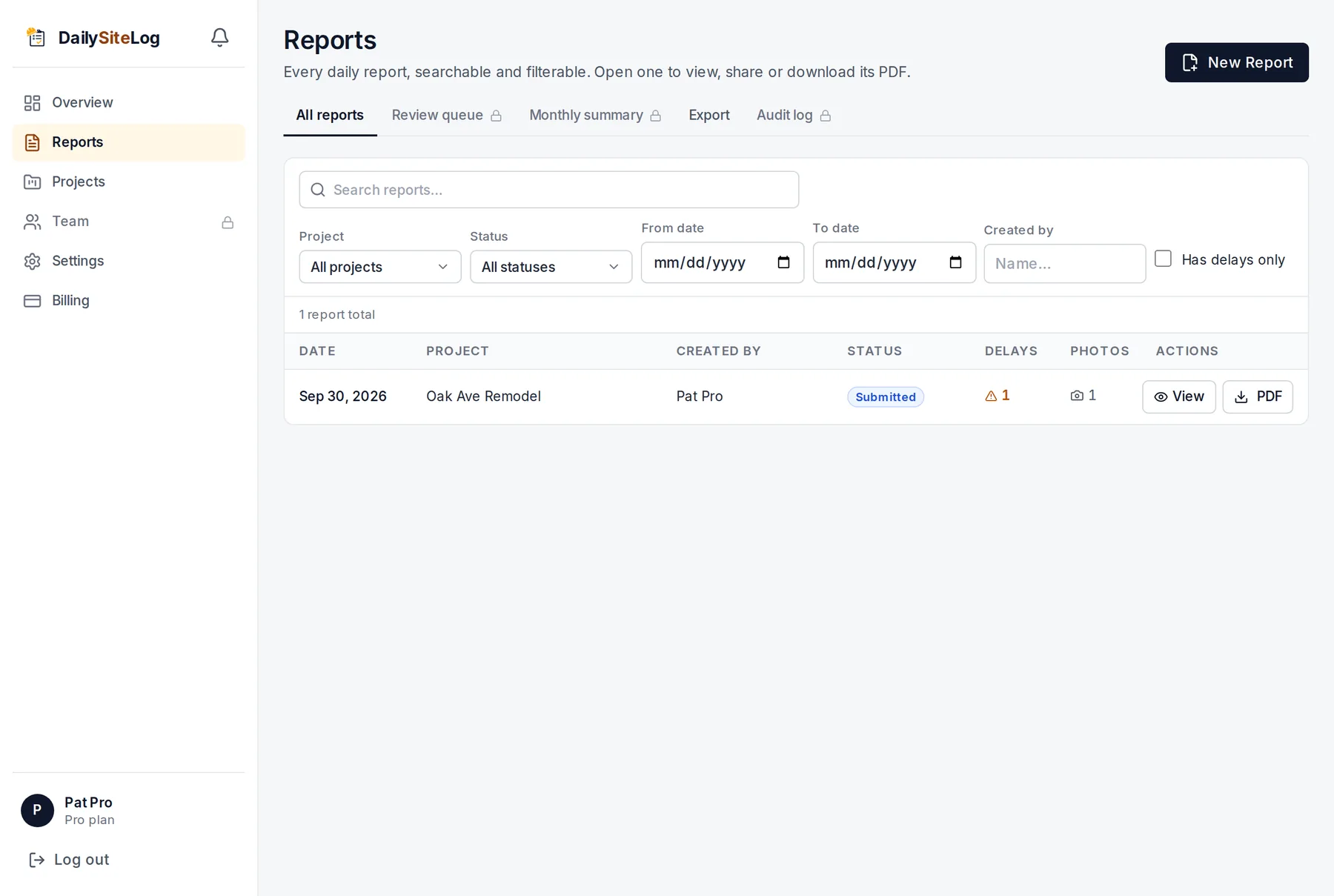
If you use software, check that the PDF header carries whichever title your client expects; Daily Site Log titles the PDF "Construction Daily Report" and includes the sections above, and the same PDF serves as the site diary or DPR for clients who call it that.
Common mistakes
- Keeping two records that disagree. A candid log and a sanitised report with different facts is the worst outcome; keep one truthful record.
- Treating the log as optional on quiet days. A day with no entry is a missing record, not a quiet one.
- Log book pages torn out or entries erased. Strike through, initial, date.
- Assuming the spec does not require reports. It is usually in Division 01, not in the general conditions.
- No visitor or instruction record. The verbal instruction you cannot prove is the change order you will not be paid for.
- Format changes mid-project. Pick the ten sections and keep them for the duration.
Sources
- AIA A201-2017 General Conditions of the Contract for Construction
- ConsensusDocs 200 Standard Agreement and General Conditions
- FIDIC Conditions of Contract (bookshop)
- JCT contracts
- NEC contracts
Frequently asked questions
Is a paper daily log book still acceptable?
Yes, if it is bound (not loose-leaf), written in ink, dated and signed daily, kept in sequence with no torn pages, and any corrections are struck through and initialled rather than erased. A bound book has one advantage over a spreadsheet: it is hard to alter after the fact. Its disadvantages are that it cannot be searched, photos live elsewhere, and only one person can read it at a time.
Does the owner get the daily log?
Depends on the contract. Many owner-contractor agreements require daily reports to be submitted (daily, weekly or on request); others only require them to be kept and made available for inspection. Superintendents often keep a personal log with candid notes in addition to the formal report. Assume anything written down can be produced in a dispute, personal or not.
What is a DPR in construction?
DPR stands for daily progress report, the standard term in India, Pakistan, Bangladesh and much of the Gulf for the same daily site record. DPR formats tend to emphasise quantities executed against the bill of quantities and cumulative progress percentages; otherwise the content matches a daily report.
Can the daily log be kept by the project manager instead of the superintendent?
It can, but it is weaker evidence. The person who observed the work should write the record; a report compiled in the office from phone calls is second-hand. If the PM must type it up, have the superintendent review and sign it the same day.
How long must daily logs be retained?
At least the contractual records-retention period, commonly three to seven years after final payment, and in practice the limitation period for claims where the project is located, which can be six to ten years or longer for latent defects. When in doubt, keep them for the life of the building. This is general information, not legal advice.